

NeverBounce has been processing email lists since 2014 — bulk verification, real-time API validation, and automated list-cleaning workflows that represented the core toolkit for serious list management. For years, it was a credible mid-market choice. Then ZoomInfo acquired it.
And in 2024, NeverBounce retroactively added 12-month expiration dates to credits that were sold without expiration. Customers who had built API integrations around persistent credits woke up to empty accounts with seven days’ notice buried in a spam folder.
The verification itself still functions, but the vendor relationship has fundamentally changed. In this review, we evaluate NeverBounce on:
- Why the credit expiration policy change is a material trust issue
- Which sender profiles can still extract value, and which should leave
- Verification methodology and where accuracy falls short of the claimed 98%+
NeverBounce’s core verification tool functions — but the platform’s post-acquisition conduct has undermined a decade of trust. Retroactive credit expiration, inflated review count claims, support that multiple long-term customers describe as unresponsive, and a 300% price hike after the ZoomInfo acquisition make this a hard recommendation for anyone planning a long-term integration.
Teams doing occasional one-off list cleaning at low volume who use credits quickly and don’t depend on them rolling over month to month.
You buy credits in bulk, need API-based intake validation with guaranteed credit persistence, or want a vendor whose pricing terms won’t change retroactively.
TLDR: NeverBounce at a glance
The key facts before the details.
| Category | Verdict |
| Best for | Occasional low-volume list cleaning |
| Entry pricing | $8 for 1,000 credits (pay-as-you-go) |
| Credit expiration | 12 months (retroactively applied in 2024) |
| Claimed accuracy | 98%+ |
| Independent test accuracy | 93–95% |
| Bounce rate guarantee | 3% or below |
| Best alternative | EmailWarmup.com email validation API |
| Overall rating | 2.8 / 5 |
How we evaluated NeverBounce
The evaluation focused on verification accuracy, pricing reliability, the post-acquisition service trajectory, and what the credit policy change means for long-term integrations. Areas covered include:
- Credit expiration impact on API-based workflows
- Verification methodology and independent accuracy testing
- How the tool’s trust issues affect vendor selection decisions
- The post-ZoomInfo support and pricing trajectory
G2 (144 reviews, 4.1/5), Trustpilot (26 reviews, 2.1/5), and Reddit r/DigitalMarketing sentiment were all reviewed.
An independent, hands-on test (1,003-email batch, published by Sparkle.io) provided verification accuracy data that NeverBounce itself doesn’t disclose.
The G2/Trustpilot gap is significant — G2 captures transactional satisfaction; Trustpilot surfaces the longer-term pattern of policy conduct.
Is NeverBounce worth the price?
Pricing, at face value, is straightforward. Pay-as-you-go credits scale down with volume, and there’s no subscription requirement for intermittent list cleaning.
| Volume | Approximate price per 1,000 credits |
| 1,000 | $8.00 |
| 10,000 | ~$4.00–$5.00 |
| 100,000 | ~$2.50–$3.00 |
| 1,000,000+ | Custom |
The model looked genuinely fair — until the credit expiration change.
When NeverBounce added a 12-month expiry to all credits in 2024 (including credits already purchased under no-expiry terms), it altered the fundamental economics for anyone who bought in bulk.
Teams that had built API integrations around a “use credits when needed” model found themselves losing hundreds to thousands of dollars in prepaid credit.
One G2 reviewer described the situation plainly — it’s like the Post Office announcing stamps will forever expire in a year.
A long-term customer also flagged a 300% price increase following the ZoomInfo acquisition, consistent with ZoomInfo’s broader enterprise pricing model being applied to a product originally positioned as affordable.
What did independent NeverBounce accuracy testing show?
The verification itself performs reasonably — though below what the marketing claims.
Independent batch test
An independent test of 1,003 emails showed:
- 795 emails returned as “valid.”
- 3 of those bounced when the campaign was sent (a 0.38% bounce rate)
- The same 3 addresses were flagged as “unsafe” by a competing tool
NeverBounce’s claimed accuracy is 98%+. Independent testing lands the figure closer to 93–95% — still serviceable, but meaningfully below the marketing claim.
Accept-all handling
The gap is most evident in accept-all domain handling. NeverBounce flags these addresses but provides no confidence score or guidance on whether they’re worth including. Users are left deciding whether to include or exclude an entire category of addresses without data.
Bounce guarantees disputes
The bounce rate guarantee (3% or below) has produced disputes. One G2 reviewer experienced a 4.3% email bounce rate on a cleaned list and described the subsequent support process as a time-wasting exercise — ultimately resolved with a $6 credit.
Pros and cons of NeverBounce
The tool has genuine strengths. The conduct around it has become harder to separate from the product evaluation.
- +Fast bulk processing — 10,000 emails in 2–10 minutes with a clean, minimal interface
- +No subscription required — pay-as-you-go is viable for teams that verify infrequently
- +85+ integrations with HubSpot, Salesforce, Mailchimp, ActiveCampaign, Marketo, and Zapier
- +Real-time API available — validates addresses at the point of entry before they enter the CRM
- −Retroactive credit expiration — credits sold without expiry were given 12-month limits with minimal notice
- −Inflated review count advertised on-site (claimed 7,000+ G2 reviews; actual count was ~138)
- −Accuracy falls short of claimed 98%+ — independent testing shows 93–95% with “valid” addresses still bouncing
- −No confidence scoring for accept-all domains — flagged but no guidance on whether to include or exclude
- −Support has declined significantly post-acquisition — AI-generated responses, slow turnaround, no accountability
Who should and shouldn’t use NeverBounce?
The profile of who should use NeverBounce has narrowed considerably since 2024.
Who should still use it
- Occasional users verifying lists a few times per year, consuming credits quickly
- Marketers doing straightforward bulk list cleaning before one-off campaigns
- Teams already embedded in the 85+ integration ecosystem
Who should look elsewhere
- Teams running API-based intake validation at variable volume
- Organizations buying credits quarterly or annually for email list hygiene workflows
- Teams where sender reputation depends on catching every risky address
- Anyone who prioritizes vendor trust and pricing predictability
The credit expiration issue isn’t just a billing inconvenience.
For teams that integrated NeverBounce into CRM workflows and bought credits in bulk because they wouldn’t expire, the retroactive policy change breaks a contractual premise.
Several Trustpilot reviewers documented this with screenshots and invoices. The company’s response — the policy changed, nothing can be done — did lasting reputational damage.
How does NeverBounce score on verification criteria?
Evaluated on verification-relevant criteria.
| Category | Score | Notes |
| Pricing | 2/5 | Retroactive credit expiry changes the value proposition |
| Ease of setup | 4.5/5 | Clean UI, fast onboarding, 85+ integrations |
| Verification accuracy | 3/5 | 93–95% independent; accepts all left unscored |
| Deliverability impact | 3/5 | Reduces bounces, but not to the extent claimed |
| Accept-all handling | 2/5 | Flagged, but no confidence scoring |
| Reporting | 3.5/5 | Bulk results clearly categorized |
| Support | 2/5 | AI-generated responses, slow post-acquisition |
| Pricing transparency | 1.5/5 | Retroactive changes; inflated review count on website |
| API reliability | 3.5/5 | Functional; credit expiry limits API-first use |
| Overall value | 2.5/5 | Functional tool; unreliable vendor relationship |
What does NeverBounce look like in daily verification workflows?
The verification process is straightforward — upload a CSV (or connect via Sync), let the batch process run, and download categorized results.
Processing speed
Processing 10,000 emails takes roughly 2–10 minutes — genuinely fast for bulk work.
Verification pipeline
The multi-step verification checks:
- Syntax
- Domain existence
- MX record validity
- SMTP server response
Accept-all domains
Accept-all (catch-all) domains present a structural challenge — the domain will accept mail regardless of whether the specific address exists.
NeverBounce flags these correctly, but doesn’t provide a risk score. Other tools offer confidence percentages for catch-all addresses; NeverBounce leaves the decision entirely to the user.
Unknown address credits
Unknown addresses also still cost credits (unlike some competitors who refund credits for unknowns). For lists with high catch-all or unknown rates, this credit model becomes expensive without yielding better decision-making data.
What happens if you stop using NeverBounce?
Credits expire within 12 months of purchase — there’s no grace period or rollover option:
- Stopping a subscription doesn’t extend the expiry
- No data export of historical verification results beyond individual batch output
- Lists cleaned more than 60–90 days ago need re-verification before sending
- B2B addresses change at ~22% annually, compounding the email bounce rate risk
A better alternative to NeverBounce | EmailWarmup.com
Where NeverBounce validates at a point in time and charges you for credits that expire, the EmailWarmup.com email validation API validates at intake — blocking bad addresses before they enter your CRM or sequence.
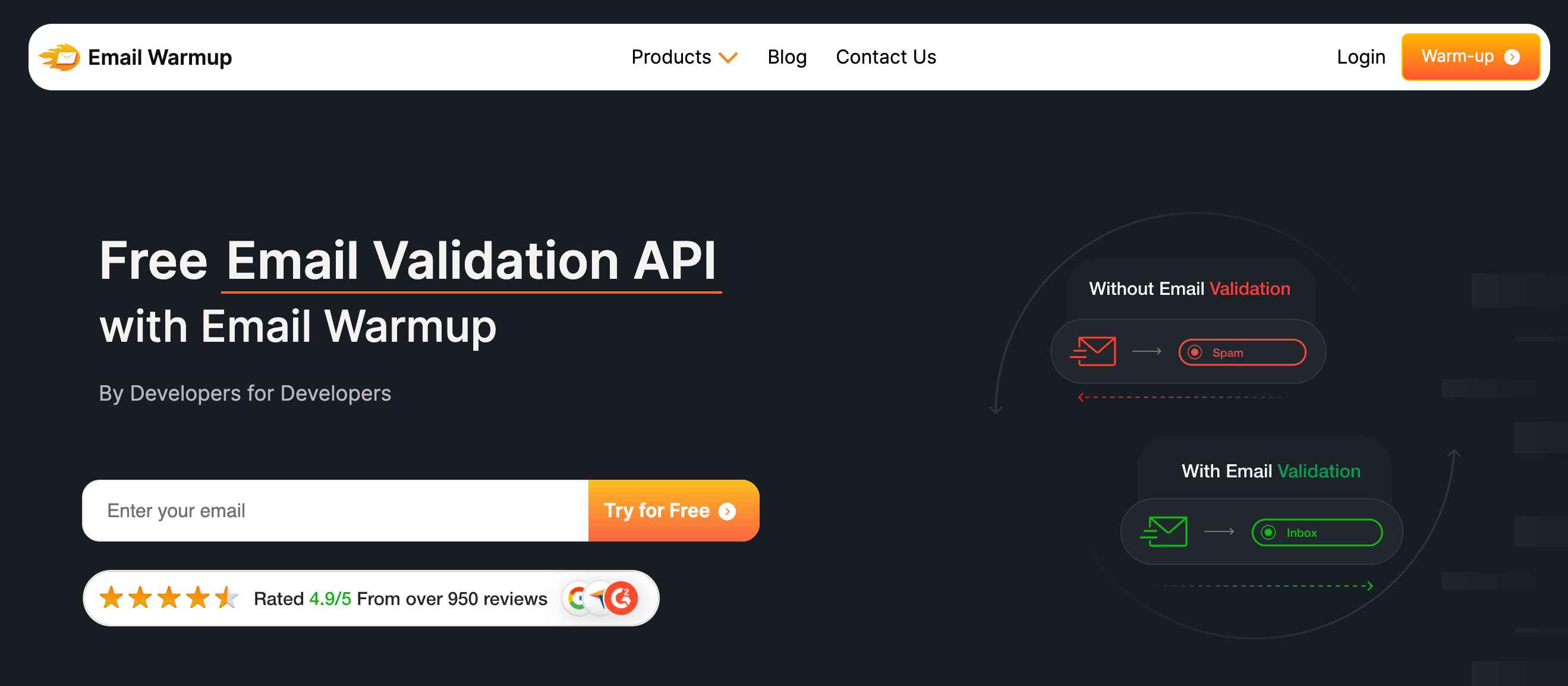
Addresses that fail at the point of entry never accumulate in your pipeline. Addresses that were valid at export but have since changed still get sent to. Intake validation closes that gap:
- REST/JSON API with SDKs in 8 languages
- No retroactive policy changes to worry about
- Blocks disposable addresses and spam traps at the intake layer
- Real-time checks on format, domain, mailbox existence, and risk signals
- 100 free credits to test integration before committing
- Unlimited deliverability consultation included
- SOC 2 Type II and GDPR compliant
For outbound teams on HubSpot, Apollo, or Instantly, intake validation protects domain reputation continuously rather than relying on periodic batch cleaning.
Final verdict
NeverBounce’s verification tool is functional — fast, reasonably accurate, and well-integrated with common marketing platforms.
- For occasional, low-stakes list cleaning where credits get used quickly, it still works
- The 85+ integration ecosystem is genuinely broad
- Bulk processing speed is competitive
The harder question is whether you should build any dependency on NeverBounce as a vendor.
The retroactive credit expiration, inflated review count, post-acquisition support decline, and price increases collectively describe a company that has changed its relationship with customers — and not in a direction that rewards loyalty.
For anything requiring a reliable API integration or a vendor relationship you can count on, the risk calculation has shifted significantly since 2024.
Frequently asked questions
Here are some commonly asked questions about NeverBounce.
Yes. In 2024, NeverBounce — now owned by ZoomInfo — introduced a 12-month expiration on prepaid credits. Applied retroactively to credits originally sold without expiration. Multiple long-term customers reported losing hundreds to thousands of dollars with minimal advance notice.
NeverBounce claims 98%+ accuracy. An independent test of 1,003 emails showed results closer to 93–95%, with three addresses marked “valid” that bounced when a campaign was sent. The gap is meaningful for email deliverability rate management.
Accept-all domains are flagged as a separate category. NeverBounce doesn’t provide a confidence score or risk percentage, leaving users to decide without supporting data.
Yes. Unlike some verification tools that refund credits for “unknown” results, NeverBounce charges credits regardless of outcome.
Multiple long-term reviewers describe the post-acquisition experience as significantly worse. Common themes include AI-generated support responses, slower turnaround, pricing increases up to 300%, and retroactive credit expiration. Reviewers who praised NeverBounce for years describe leaving specifically because of post-acquisition conduct.