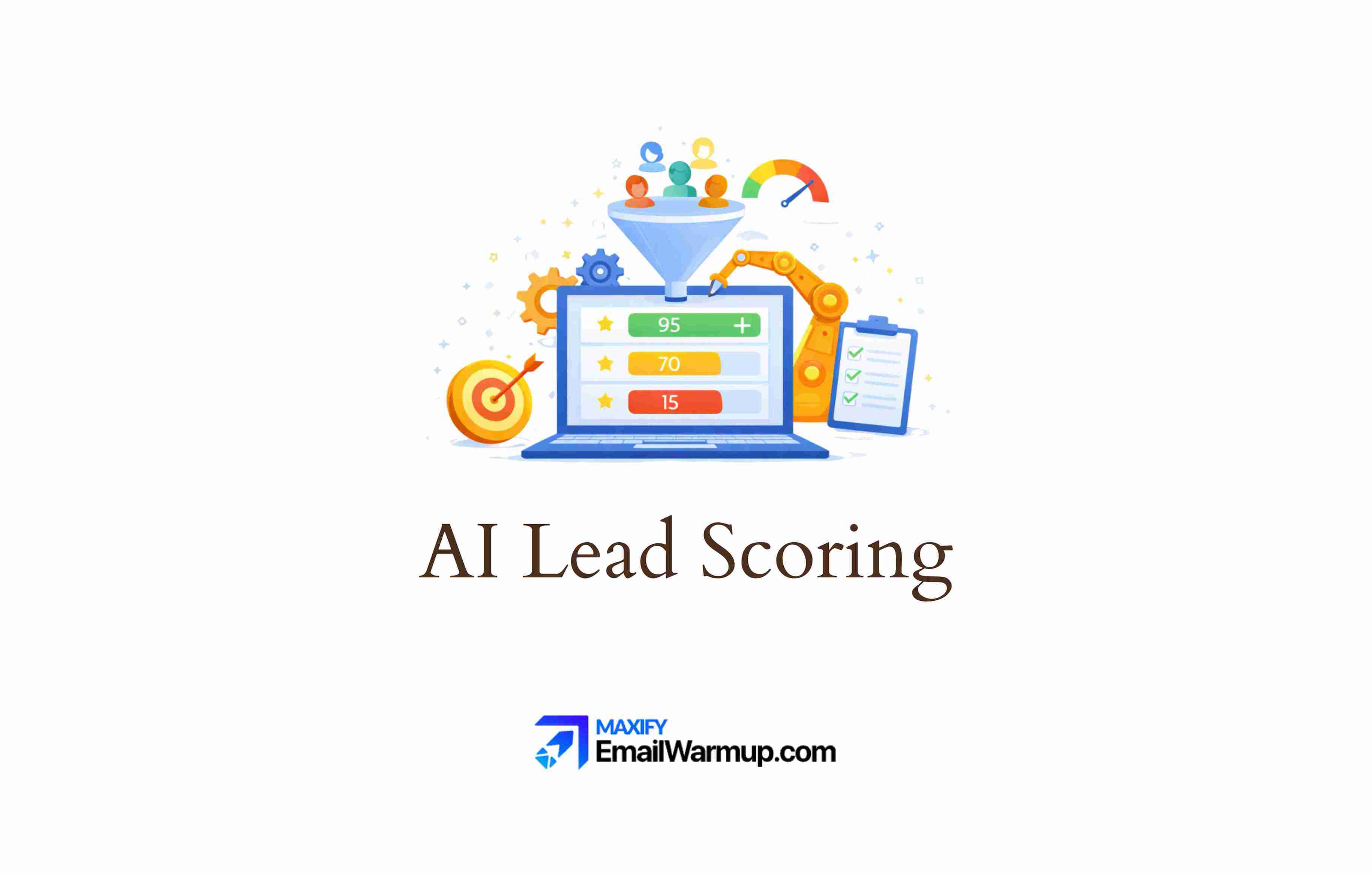
Automated lead scoring uses machine learning to rank prospects by their likelihood to convert — replacing manual point systems that decay the moment you set them up.
Traditional scoring assigns fixed points to arbitrary actions:
- 20 for a VP title
- 5 for an email open
- 10 points for a form fill
The problem is that those weights reflect guesses, not reality. Automated scoring analyzes thousands of historical conversions to discover which signals actually predict deals.
What changes when you automate:
- Sales stops chasing leads that were never going to close
- Marketing stops arguing about what qualifies as “sales-ready.”
- Revenue teams focus exclusively on high-probability opportunities
The technology existed for years at enterprise price points. Now it integrates with standard CRMs and marketing platforms — accessible to teams that couldn’t justify six-figure investments.
How does automated lead scoring work?
The core shift happens in how scoring rules get created. Traditional systems require humans to define what matters. Automated systems discover it from your own data.
Rules vs predictions
Traditional lead scoring works like a checklist. Download a whitepaper, earn 10 points. Visit the pricing page, earn 15. Have a VP title, earn 20. Humans define these rules based on assumptions about buyer behavior.
Automated scoring inverts the process entirely. The AI analyzes your historical wins and losses, identifies which characteristics and behaviors actually correlated with conversion, and builds a predictive model. The machine discovers patterns humans would miss — or get wrong.
| Factor | Traditional (manual) | Automated (AI-powered) |
| Rule creation | Human-defined, static | Machine-learned, dynamic |
| Scoring logic | Fixed points per action | Weighted by actual conversion correlation |
| Adaptation | Requires manual updates | Self-adjusts based on outcomes |
| Data capacity | Limited to obvious signals | Processes thousands of variables |
| Accuracy over time | Degrades without maintenance | Improves with more data |
A manual system might always give 10 points for downloading a case study. An automated system evaluates that download in context — the lead’s company size, their recent website activity, and how similar leads behaved after the same action. Context changes everything.
What data feeds into scoring models?
Automated scoring synthesizes information from across your technology stack. The more complete the picture, the more accurate the predictions.
Demographic and firmographic signals
The foundation includes who the person is and what company they represent:
- Industry vertical
- Geographic location
- Department and function
- Job title and seniority level
- Company size and revenue
These determine ICP fit — whether the lead could be a good customer, regardless of current interest level. A perfect behavioral profile from a company outside your serviceable market still scores lower than a moderate fit within it.
Behavioral and engagement signals
The model tracks how prospects interact with your brand:
- Content downloads
- Webinar attendance
- Product demo requests
- Website visits and page depth
- Email opens, clicks, and replies
Behavioral signals indicate interest intensity. A lead matching your ICP who never engages scores lower than one actively consuming content — even if the engaged lead’s company profile is slightly weaker.
Intent signals
Third-party intent data reveals research activity happening outside your properties:
- Competitor comparisons
- Solution category searches
- Technology review site activity
- Industry publication engagement
Intent signals surface leads who are actively evaluating solutions — sometimes before they’ve engaged with you directly. Someone researching your category on G2 or Capterra signals purchase consideration that website visits alone wouldn’t reveal.
How does the scoring process actually work?
The technical flow moves from raw data to actionable scores through several phases. Understanding the process helps set realistic expectations about what the technology can (and can’t) do.
Data collection
The system ingests data from your CRM, marketing automation platform, website analytics, and (optionally) third-party intent providers. Integration happens via native connectors or APIs — most modern platforms support the standard tools.
Model training
The AI compares your closed-won deals against closed-lost opportunities. It identifies which combinations of attributes and behaviors distinguished winners from losers — and assigns weights accordingly.
Unlike manual scoring, these weights adjust automatically. If email opens stop predicting conversion (because everyone opens but few buy), the model reduces that signal’s importance without human intervention.
Real-time scoring
Once trained, the model evaluates new leads instantly. Each prospect receives a score — typically 0-100 — representing conversion probability within a defined timeframe (often 90 days).
| Score range | Typical interpretation | Recommended action |
| 80-100 | High-intent, ready to buy | Immediate sales outreach |
| 50-79 | Interested, needs nurturing | Automated email sequences |
| 20-49 | Early stage, low urgency | Marketing continues engagement |
| 0-19 | Poor fit or disengaged | Deprioritize or remove |
Continuous learning
The model retrains periodically — often every 10-15 days — incorporating new outcomes. This keeps scoring aligned with changing buyer behaviors and market conditions without manual reconfiguration.
Market shifts happen constantly. A static model loses accuracy over months. A learning model adapts.
What are the business benefits?
The appeal goes beyond technical elegance. Automated scoring changes how revenue teams operate day-to-day.
Efficiency gains
Manual qualification doesn’t scale. When lead volume spikes, quality suffers — reps rush through evaluations or skip them entirely. Automated scoring handles volume increases without additional headcount.
Research suggests AI-powered qualification can reduce speed-to-lead by up to 31%. Leads get scored and routed within minutes, not hours. That speed matters because interest decays fast (a lead who requested a demo yesterday is warmer than one who requested it last week).
Accuracy improvements
Human scoring reflects human bias. Reps favor leads that “feel” right based on limited information. Marketing assigns points based on assumptions that may have never been true.
Automated scoring relies on outcome data. The model doesn’t care which leads should convert — only which leads actually did. Pattern recognition at scale beats intuition.
Team alignment
The most common source of revenue team friction: disagreement over lead quality. Sales says marketing sends garbage. Marketing says sales ignore good leads.
Automated scoring creates a shared definition of “qualified.” Both teams operate from the same criteria, defined by conversion data rather than opinions.
How does email engagement affect lead scores?
Email behavior provides some of the clearest intent signals available. The connection to sender reputation and deliverability matters more than most teams realize.
Email as scoring input
Different engagement patterns mean different things:
- Replies indicate active consideration
- Forwards suggest internal discussion
- Clicks indicate interest in specific topics
- Opens indicate awareness and recognition
A lead who opens every email but never clicks scores differently from one who clicks pricing links repeatedly. The pattern reveals intent — or its absence.
Deliverability affects accuracy
Scoring models can only evaluate engagement that they can see. If your emails land in spam, the model has no data to learn from — and misclassifies interested prospects as disengaged.
This is where email validation and deliverability best practices connect to lead scoring. Clean lists and strong inbox placement ensure engagement signals reach your scoring system. Poor deliverability creates blind spots.
For teams running cold email follow-up sequences, scoring helps prioritize which responses deserve immediate attention versus which can wait for batch processing.
What does implementation require?
Automated scoring isn’t plug-and-play. The technology requires certain foundations to function accurately.
Data foundation
Clean, integrated data forms the prerequisite. Duplicates, inconsistent formatting, and missing fields degrade model accuracy. Most implementations start with a CRM audit and data standardization project — not glamorous work, but necessary.
Historical outcomes
The model needs training data — ideally 6-12 months of closed-won and closed-lost records with associated lead attributes and behaviors. Without this history, the AI has nothing to learn from.
Smaller organizations face a catch-22: they need scoring to improve conversion, but need conversion data to build accurate scores. Starting with rule-based scoring and transitioning to automated once you’ve accumulated 500+ historical outcomes often works better than forcing automation too early.
Defined thresholds
A score means nothing without corresponding action:
- Who receives leads in the 60-80 range?
- What happens when someone scores 85+?
- How long do low-scoring leads stay in nurture before removal?
Teams that implement scoring without defining workflows end up with beautifully ranked lists that nobody acts on differently.
Feedback loops
Sales must report back on score accuracy. Did high-scoring leads actually convert? Did low-scoring leads surprise? This feedback retrains the model and maintains alignment with reality.
Without feedback, models drift. A system optimized for last year’s buyer behavior becomes less accurate as markets evolve.
What platforms offer automated scoring?
The market spans enterprise solutions to DIY approaches. Platform selection depends on existing infrastructure, budget, and technical capacity.
| Category | Examples | Best for |
| Enterprise | Demandbase, 6sense, Salesforce Einstein | Large teams, complex sales cycles |
| Mid-market | HubSpot, Marketo, Pardot | Established marketing ops |
| DIY/Low-code | Make.com + ChatGPT + spreadsheets | Budget-conscious, technical teams |
Enterprise platforms offer the most sophisticated models but require significant investment. Mid-market tools include native scoring features that work well for most B2B companies.
Automated scoring makes resource allocation accurate
Sales focuses on leads most likely to convert. Marketing gets clearer feedback on which programs generate quality. Revenue becomes more predictable.
The technology requires clean data and strong deliverability to function accurately — engagement signals that never reach your system can’t inform your model.
For teams wanting to improve the email metrics that feed scoring, an email marketing consultant can help diagnose gaps between sends and measurable engagement.
Frequently asked questions
Here are some commonly asked questions about automated lead scoring:
Automated lead scoring is a specific application of predictive analytics focused on ranking prospects. Predictive analytics is the broader discipline — scoring uses those techniques to answer one question: which leads should sales prioritize?
Basic implementations can launch in 2-4 weeks with clean data and clear ICP definitions. Complex integrations with multiple data sources and custom model training may take 2-3 months. The data cleanup phase usually takes longer than the technical configuration.
Models need sufficient data to identify patterns. With fewer than 500 historical conversions, predictions may be unreliable. Smaller organizations often start with rule-based scoring and transition to automated once they accumulate more outcome data.
Absolutely. Models optimize for historical patterns that may not hold in future markets. Feedback loops catch drift, but no model achieves perfect accuracy. The goal is better than manual scoring — not perfection.