
Bouncer is a GDPR-compliant email verification platform built around high-accuracy validation, real-time API access, and a Toxicity Check feature. The service positions itself as a “fortress-like” solution for protecting sender reputation through rigorous list hygiene.
The 99.5% accuracy claim sounds impressive on paper. But email verification lives and dies by edge cases — particularly catch-all domains, which represent one of the hardest problems in list cleaning.
This review examines whether Bouncer delivers reliable results where it matters most. In this guide, you’ll learn:
- How Bouncer’s verification accuracy holds up in practice
- Who should use Bouncer, and who needs alternatives
- Where catch-all handling creates real-world friction
- What the Toxicity Check actually identifies
Quick skim — Bouncer overview
Here’s the snapshot before breaking down each area.
| Category | Verdict |
| Best for | GDPR-conscious teams needing bulk verification + toxicity screening |
| Starting price | $8 per 1,000 credits (pay-as-you-go) |
| Free trial | 100 free credits on signup |
| Standout feature | Toxicity Check (spam traps, complainers, litigators) |
| Biggest weakness | Catch-all verification requires careful handling |
| Best alternative | EmailWarmup.com |
| Overall rating | 4.0 / 5 |
How we evaluated Bouncer
The assessment reflects how consultants evaluate verification tools for real client implementations.
We examined:
- GDPR compliance and data handling
- API performance and integration options
- Accuracy across standard and catch-all domains
- Toxicity Check detection capabilities
- Pricing value against alternatives
Is Bouncer worth the price?
Bouncer uses a pay-as-you-go credit system where credits never expire — a genuine advantage over subscription models that force monthly commitments.
Pricing structure
| Credits | Cost | Per-email rate |
| 1,000 | $8 | $0.008 |
| 5,000 | $35 | $0.007 |
| 10,000 | $60 | $0.006 |
| 50,000 | $250 | $0.005 |
| 250,000 | $750 | $0.003 |
| 1,000,000 | $2,000 | $0.002 |
Bouncer also offers a Starter subscription at $25/month for deliverability monitoring (separate from verification credits).
Credit policy
Bouncer doesn’t charge for “unknown” results — credits are returned to your account when verification can’t determine the status. New users receive 100 free credits to test before committing.
Value assessment
Pricing sits in the mid-range for verification tools. Volume discounts become meaningful at 50,000+ credits. For EU-based operations where GDPR compliance and data handling matter, premium-over-budget alternatives make sense.
What do real verification results show?
Bouncer claims 99.5% accuracy through SMTP-based verification. Real-world performance largely aligns with this for standard domains — with one notable exception.
Standard verification
The multi-step process works reliably:
- Syntax and domain validation catch obvious errors
- MX record detection identifies the mail server configuration
- SMTP verification confirms the existence of the respective mailbox
- Results are categorized into Deliverable, Risky, Undeliverable, and Unknown
Processing speeds reach up to 200,000 emails per hour (impressive for bulk operations).
Catch-all challenge
Catch-all domains (servers that accept all incoming mail regardless of whether the specific address exists) represent a particularly difficult verification challenge.
Bouncer’s integration guidelines explicitly treat accept-all addresses as a special, risky case.
The practical approach: treat catch-alls as a separate segment, send small test batches first, and monitor bounce rates before scaling volume.
What are Bouncer’s strengths and weaknesses?
Every verification tool involves trade-offs. Here’s where Bouncer delivers — and where it falls short.
Toxicity Check identifies spam traps, complainers, and litigators beyond basic validation.
Full GDPR compliance with EU data centers and automatic 60-day deletion.
Credits never expire; no charge for unknown results.
Bouncer Shield blocks invalid entries on forms without coding.
Catch-all verification marks addresses as “risky” without definitive status.
Data auto-deletes after 60 days — redownload before expiration.
Mid-range pricing may not suit teams with tight budgets at low volumes.
Accept-all domains require manual segmentation decisions.
Who should and should not use Bouncer?
The right fit depends on your list composition, compliance requirements, and verification priorities.
Recommended if
- GDPR compliance is a non-negotiable requirement
- Your lists need toxicity screening beyond basic validation
- Native integrations with HubSpot, Klaviyo, or Mailchimp cover your stack
- You prefer pay-as-you-go over forced subscriptions
Not recommended if
- Heavy catch-all domains dominate your lists, and you need definitive decisions
- You need aggressive catch-all validation with clear accept/reject outcomes
- Budget is the primary factor at low verification volumes
Category scorecard
| Category | Score | Notes |
| Pricing | 3.5/5 | Mid-range; credits never expire |
| Ease of setup | 4/5 | Clean interface, intuitive workflow |
| Core functionality | 4/5 | Strong standard verification |
| Deliverability impact | 4/5 | Toxicity Check adds real value |
| Diagnostics depth | 3.5/5 | Good categorization, catch-all caveat |
| Reporting | 4/5 | Clear results with pie charts |
| Support | 4/5 | Generally well-reviewed |
| Scalability | 4/5 | Handles 200K emails/hour |
| Provider compatibility | 4/5 | Zapier, HubSpot, Klaviyo, Mailchimp |
| Overall value | 4/5 | Strong for GDPR-conscious teams |
How does Bouncer actually perform?
Day-to-day operations reveal the practical reality behind feature descriptions.
Verification workflow
Uploads happen via drag-and-drop or direct integrations (HubSpot, Klaviyo, Mailchimp, GetResponse). Results download as CSV with clear status labels.
The Bounce Estimate feature samples your list for free before full verification — useful for predicting costs on large uploads.
Toxicity Check
The standout feature scores addresses 0–5 based on risk factors:
- Widely circulated or breached addresses
- Litigators (yes, people who sue senders)
- Known spam complainers
- Potential spam traps
Bouncer’s documentation explains how to interpret toxicity values, enabling you to set appropriate thresholds aligned with your risk tolerance.
API performance
Real-time verification returns results within 10 seconds (with a maximum of 30 seconds for complex cases). Batch processing handles 100,000–200,000 emails per hour. Both synchronous and asynchronous endpoints are available.
What happens after verification?
Verified data auto-deletes after 60 days for GDPR compliance. Download results promptly or re-run verification closer to campaign launch.
For ongoing list hygiene, Bouncer offers AutoClean (available for HubSpot and Klaviyo) that maintains data quality without manual intervention. Bouncer Shield handles real-time form protection to prevent bad addresses from entering your database in the first place — and it works without coding.
A better alternative | EmailWarmup.com
For teams needing verification integrated into their broader deliverability infrastructure, EmailWarmup.com’s email validation API offers a more cohesive approach.
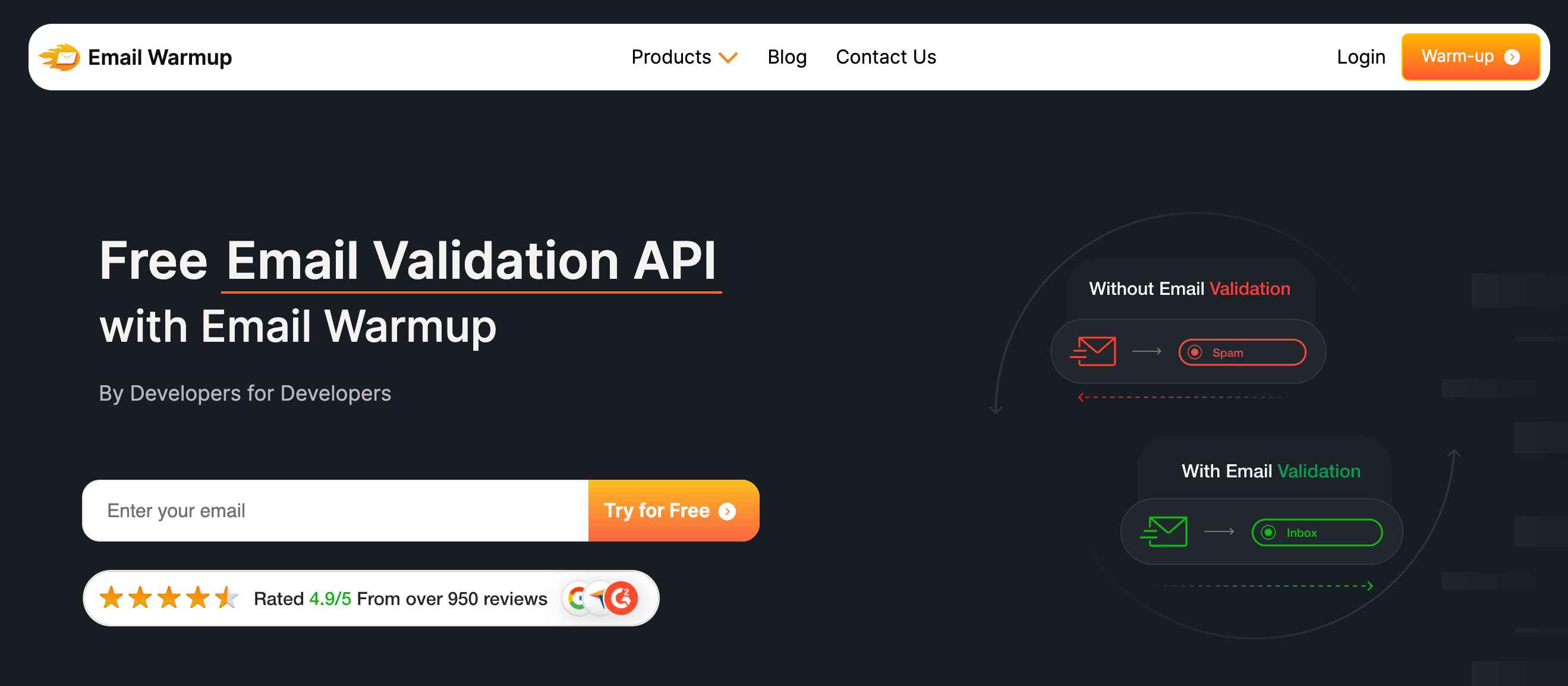
The API verifies format, domain, mailbox existence, and risk factors in real-time — blocking disposable addresses, spam traps, and typos before they enter your CRM. SOC 2 Type II and GDPR compliance are included by default.
Key capabilities:
- 100 free credits for testing
- SDKs in 8 programming languages
- Real-time verification via REST/JSON API
- Blocks disposables and spam traps at capture
- Pairs with email warmup and deliverability testing
- Deliverability consultants available for all kinds of cases
Final verdict
Bouncer delivers strong verification for standard email validation with genuine advantages in GDPR compliance and toxicity screening.
The Toxicity Check adds value that basic validators miss — identifying spam traps and complainers protects domain reputation beyond simple deliverability.
The limitation is catch-all handling. Accept-all domains get flagged as “risky” without definitive resolution, which means additional segmentation work on your end. For standard consumer lists and GDPR-conscious European operations, Bouncer represents solid value at mid-range pricing.
Frequently asked questions
Here are some commonly asked questions about Bouncer:
Bouncer claims 99.5% accuracy through SMTP-based verification. Results align with this for standard verification, though catch-all domains produce less definitive outcomes.
No. Credits return to your account when verification can’t determine status — a fair policy that competitors don’t always match.
The feature scores address 0–5 for risk factors, including spam traps, widely breached emails, known complainers, and litigators.
Uploaded data auto-deletes after 60 days for GDPR compliance. Download verification results before expiration if you need them later.