

Proofy is a lean email verification service built for one purpose — cleaning email lists before they cause deliverability problems. Upload a CSV, run the batch, download the results. There are no subscription traps or hidden complexity.
For freelancers, small agencies, and solo marketers running occasional campaigns, that simplicity is exactly what makes Proofy work. The verification itself holds up well for straightforward cases, and the pricing ($0.003/credit with no expiry) is genuinely hard to beat.
Where it falls short is depth — catch-all domain handling is basic, intake validation is limited, and there’s no deliverability monitoring beyond the verification itself.
In this guide, you’ll learn:
- What Proofy’s verification pipeline covers and what it misses
- How pricing compares to alternatives at different volume levels
- Which senders benefit most, and where the tool’s depth becomes a constraint
- Why EmailWarmup.com’s Email Validation API handles the gaps Proofy leaves
Proofy delivers on its core promise — affordable, fast, and reasonably accurate batch email verification. The user experience is genuinely clean, the pricing is transparent, and the tool doesn’t oversell itself. Where it falls short is depth: accept-all domain handling is basic, intake validation is limited, and there’s no deliverability monitoring beyond the verification itself. Honest budget tool. Not a complete deliverability solution.
Freelancers, small agencies, and solo marketers who need affordable batch list cleaning without a long-term commitment or complex setup.
You need real-time intake validation with confidence scoring, spam trap detection, or any deliverability monitoring beyond basic bounce prevention.
TLDR: Proofy at a glance
Everything you need before going further.
| Category | Verdict |
| Best for | Low-to-mid volume batch list cleaning |
| Pay-as-you-go | $30 per 10,000 credits ($0.003/credit) |
| Monthly plan | $26 per 10,000 credits ($0.0026/credit) |
| First-time entry | $4 for 1,000 credits |
| Processing speed | 100,000 emails in ~45 minutes |
| Credit expiry | No expiration |
| Best alternative | EmailWarmup.com email validation API |
| Overall rating | 3.8 / 5 |
How we evaluated Proofy
Proofy was evaluated specifically as a verification and bounce-prevention tool — not as a general deliverability platform. Areas covered include:
- API usability for intake validation
- Accuracy claims versus real-world user outcomes
- Feature set constraints for serious email programs
- Pricing relative to comparable tools at different volumes
Review data came from G2 (275 reviews, 4.7/5), Trustpilot (309 reviews, 4.9/5), and Software Advice/Capterra (545 reviews, 4.8/5).
The remarkably consistent high scores across all three platforms — unusual for a verification tool at this price point — are worth taking seriously.
Most negative feedback clusters around the limited free plan and absence of live chat support, rather than accuracy or reliability failures.
Is Proofy worth the price?
The pricing structure is one of Proofy’s strongest points — genuinely refreshing after seeing what competitors do with credit expiration policies.
| Plan | Price per 10,000 | Per credit | Commitment |
| Pay-as-you-go | $30 | $0.003 | None |
| Monthly | $26 | $0.0026 | Cancel anytime |
| First-timer offer | $4 for 1,000 | $0.004 | None |
Credits don’t expire, and there’s no subscription trap.
For context, NeverBounce charges roughly $8 per 1,000 at the entry level — Proofy comes in at $3 per 1,000. A 10,000-email list costs $30 with Proofy versus $80 with NeverBounce. Multiple reviewers switched to Proofy specifically after comparing costs.
One thing to plan for — credits for invalid and unknown results still cost you. Unlike some tools that refund credits for addresses returning no result, Proofy charges regardless of outcome.
For lists with high proportions of catch-all or unknown addresses (common in certain B2B niches), this adds up faster than the per-credit rate suggests.
What did our Proofy accuracy analysis reveal?
Proofy claims 99% accuracy — a figure that should be held loosely. Real-world results are more nuanced but generally positive.
Batch cleaning results
One Software Advice reviewer achieved a 0% bounce rate after cleaning a list through Proofy twice (the second pass caught stragglers the first missed — a known limitation worth planning for).
A Trustpilot reviewer cleaned a 68,000-address list and reported dramatic drops in email bounce rate. One G2 reviewer processing several hundred API calls daily cited the tool as “solid and fast” with no notable accuracy complaints over two years.
Catch-all handling
The catch-all domain handling is where accuracy gaps show up most visibly. Proofy flags accept-all addresses correctly, but doesn’t provide a risk percentage or confidence score — leaving users to decide without supporting data whether to include or exclude the entire category. One Software Advice reviewer noted occasional false positives or negatives with catch-all domains.
Typo correction
The typo correction feature (which fixes obvious email mistakes like @gmial.com or @outlok.com before they reach the list) is a small but genuinely useful touch. One enterprise reviewer in the healthcare space noted that roughly 4% of people mistype their email address — Proofy catches those automatically.
Pros and cons of Proofy
The platform is well-liked, and the criticism is mostly structural rather than about core reliability.
- +Genuinely affordable — $0.003 per credit with no subscription required and no credit expiry
- +Fast bulk processing — 100,000 emails in approximately 45 minutes
- +Typo correction catches address mistakes in real time at the point of form entry
- +Consistently high user sentiment across G2, Trustpilot, and Capterra — rare for budget tools
- +Clean, minimal interface that requires no learning curve for basic list verification
- −No confidence scoring for catch-all domains — flagged but given no risk percentage
- −Limited free plan (100 credits) makes meaningful pre-purchase testing difficult
- −No live chat support — async support only, which slows resolution during active campaigns
- −File upload limited to CSV/TXT up to 65MB — can require workarounds for very large lists
- −API requires two calls to verify a single email — adds friction for real-time, high-frequency validation
Who should and shouldn’t use Proofy?
Proofy fits a well-defined profile — teams that send periodically, work within modest budgets, and don’t have unusually high concentrations of catch-all domains.
Who should use it
- Freelancers and consultants running cold outreach need affordable per-use cleaning
- Developers needing a quick-integration API for signup form validation
- Small agencies managing client lists before campaign launches
- Newsletter senders doing periodic email list hygiene passes
Who shouldn’t use it
- Teams needing real-time, high-frequency API verification
- Anyone needing deliverability monitoring after verification
- Marketing operations teams needing CRM-native integration
- High-volume B2B senders with heavy catch-all enterprise domains
Proofy’s lack of live chat support has come up enough in reviews to be worth flagging for teams running time-sensitive campaigns. If you need help on a Friday afternoon before a Monday send, async support is a real constraint.
How does Proofy score on verification-specific criteria?
Measured against the deliverability criteria that run across this review series.
| Category | Score | Notes |
| Pricing | 5/5 | Best-in-class for volume; transparent, no credit expiry |
| Ease of setup | 4.5/5 | Minimal interface; CSV upload in minutes |
| Verification accuracy | 3.5/5 | Solid on clear-cut cases; catch-all handling is basic |
| Deliverability impact | 3.5/5 | Reduces bounces well for valid/invalid categories |
| Accept-all handling | 2.5/5 | Flagged correctly, but no confidence score provided |
| Reporting | 3.5/5 | Results clearly categorized; no historical dashboard |
| Support | 3/5 | Responsive via email; no live chat option |
| API reliability | 3.5/5 | Functional; two-call architecture limits high-speed use |
| Scalability | 3.5/5 | Works at volume; 65MB file limit can be a constraint |
| Overall value | 4/5 | Best cost-to-result ratio in its category |
What does Proofy look like in daily verification workflows?
The workflow is genuinely simple — partly why the user satisfaction scores are so high.
Batch cleaning
Upload a CSV, click verify, receive a categorized breakdown of valid, invalid, risky, disposable, and catch-all addresses, then download the cleaned result. No configuration required. A reasonably tech-comfortable user can go from signup to clean list in under 10 minutes.
Verification pipeline
The pipeline runs through multiple checks:
- Syntax checks
- SMTP server confirmation
- Duplicate removal (automatic)
- Domain and MX record validation
Real-time widget
The real-time widget option — where you install a snippet on a signup form — validates addresses at the point of entry, keeping bad data from entering your CRM rather than cleaning it out later.
Operational considerations
Two operational realities to plan around. First, some lists benefit from a second pass (one reviewer noted that running a list through Proofy twice caught additional bad addresses).
Second, large-batch processing can slow down under load — reviews of lists above 50,000 occasionally mention processing delays beyond the 45-minute benchmark.
The email bounce rate impact is real. Multiple reviewers document going from double-digit bounce rates to sub-2% after a Proofy cleaning pass — genuinely strong value at the $0.003/credit price.
What happens after Proofy verification?
Proofy’s job ends when the cleaned CSV is delivered. A few things to keep in mind:
- No IP reputation monitoring or alerting
- Lists age — B2B addresses change at ~22% annually
- The platform doesn’t track domain reputation after the send
- Re-verify before any new campaign on lists older than 90 days
- Credits don’t expire (the contrast with NeverBounce’s retroactive expiration policy is stark)
A better alternative to Proofy | EmailWarmup.com
Proofy is good at what it is. Where it runs out of road is at the deliverability layer above and below verification — intake validation that blocks bad addresses before they reach your list, and ongoing reputation monitoring after sends go out.
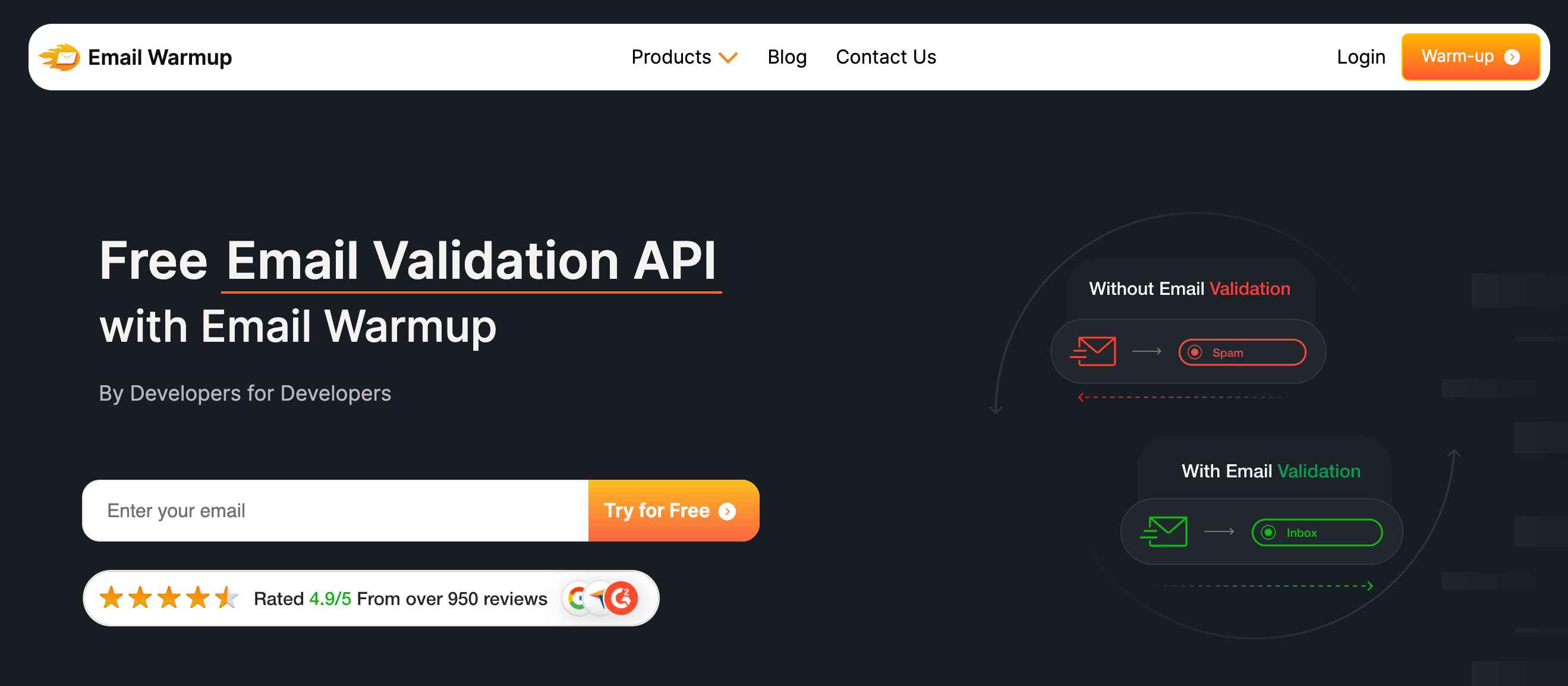
The EmailWarmup.com email validation API handles the intake side — each address is checked in real time as it arrives through a form, CRM sync, or sequence import. The address is either cleared or blocked on the spot, without a batch step afterwards.
- Real-time validation at intake, not retroactive batch cleaning
- Spam trap and disposable address blocking at the moment of entry
- REST/JSON API with SDKs in 8 languages — single call per address, not two
- 100 free credits to test the integration before committing
- SOC 2 Type II and GDPR compliant infrastructure
- Unlimited deliverability consultation included
For outbound teams sending through Apollo, HubSpot, or Instantly, the difference between cleaning a list once before a campaign and validating every contact at the point it enters your pipeline is the difference between periodic protection and continuous protection.
Final verdict
Proofy earns its high ratings across every review platform.
- At $0.003/credit with no expiry, it punches well above its price point
- Real-world bounce rate reductions are well-documented and consistent
- The clean interface and fast batch processing make it genuinely frictionless
The ceiling is real — no confidence scoring for catch-all domains, no live support, a two-call API architecture, and no deliverability layer beyond the verification itself. Use Proofy for what it’s genuinely good at. Build the rest of your deliverability stack separately.
Frequently asked questions
Here are some commonly asked questions about Proofy.
No. Unlike NeverBounce — which retroactively added 12-month expiry to previously unlimited credits — Proofy credits don’t expire. Buy in bulk when the price makes sense and use them on your own schedule.
Proofy claims 99% accuracy. User-reported results are generally positive, with many reviewers documenting significant bounce rate reductions. The accuracy gap shows up most clearly with catch-all domains, where Proofy flags the address category but provides no confidence score for individual addresses.
Yes, through a real-time validation widget embedded into registration or subscription forms. The API is also available for programmatic validation — though it requires two calls to verify a single address, adding latency for high-frequency intake email verification.
CSV and TXT files up to 65MB. For very large lists exceeding the size limit, batching into multiple uploads is the workaround. The platform doesn’t support Excel files directly, though CSV export from Excel works without issues.
Unknown addresses — those where the verification couldn’t confirm or deny deliverability — are flagged as a separate category. Credits are still charged for these results. Users with high proportions of unknowns should factor this into cost expectations.