
DeBounce positions itself as the budget email verification option — and the market seems to agree.
With over 1,300 Trustpilot reviews and strong ratings across platforms, the platform has built genuine traction among cold emailers managing list hygiene at scale.
The pricing model stands out (credits that never expire are still rare in this space). The real question is whether verification accuracy matches that value proposition.
In this guide, you’ll learn:
- What the 7-day data retention limit means for workflows
- How the pricing scales for DeBounce for high-volume verification
- Who benefits most from DeBounce, and who should look elsewhere
- Whether DeBounce’s accuracy holds up against premium competitors
Quick skim — DeBounce overview
Here’s what matters at a glance.
| Category | Verdict |
| Best for | Budget-conscious cold email teams |
| Starting price | $10 for 5,000 verifications |
| Free tier | Free credits for testing |
| Standout feature | Non-expiring PAYG credits |
| Biggest weakness | 7-day data retention; spam trap gaps |
| Best alternative | EmailWarmup.com email validation API |
| Overall rating | 4.2 / 5 |
How we evaluated DeBounce
This assessment reflects how deliverability consultants actually evaluate verification tools — looking at accuracy, workflow fit, and cost at scale rather than feature lists.
Our evaluation covered:
- Pricing at volume
- Bulk processing speed
- Verification accuracy and guarantees
- Public review patterns
- API reliability
Is DeBounce worth the price?
DeBounce uses pay-as-you-go pricing with volume discounts — and notably, credits never expire. That flexibility alone sets it apart from competitors that lock you into monthly subscriptions.
Pricing
Here’s a breakdown based on credits:
| Credits | Cost | Per Email |
| 5,000 | $10 | $0.002 |
| 10,000 | $15 | $0.0015 |
| 100,000 | $50 | $0.0005 |
| 500,000 | $150 | $0.0003 |
Value
At 100,000 emails for $50, DeBounce costs roughly one-quarter what NeverBounce charges — with users reporting nearly identical accuracy.
One reviewer ran 15,000 emails through both platforms and found the results “nearly identical” (a compelling data point).
Non-expiring credits eliminate the rush to verify lists immediately. For teams with irregular sending schedules, that flexibility matters. High-volume operations save substantially over time.
What do real results show?
DeBounce carries strong ratings across review platforms — with enough volume to draw meaningful conclusions.
Reviews
Here’s an overall situation of how reviews look at multiple platforms:
| Platform | Rating | Reviews |
| Trustpilot | ~4.8/5 | 1,343+ |
| Endorsal | 4.7/5 | 209+ |
| G2 | ~4.5/5 | 50+ |
| Capterra | Mixed | 25+ |
The company guarantees 97.5% deliverability — and user reports support this. One user documented a drop from 21% hard bounces to ~1% after implementation (we’ve seen similar patterns with other verification tools).
Strengths
- Clean interface
- Responsive support
- Accurate catch-all detection
- Fast processing (10K emails in ~10 minutes)
Gaps
- 7-day data retention limit
- Advanced features gated on higher tiers
- Spam trap detection occasionally misses
- One serious Capterra complaint — contacts incorrectly marked as opted-out
What are DeBounce’s strengths and weaknesses?
The platform hits a sweet spot for most verification needs — though enterprise requirements reveal some gaps.
Non-expiring credits — no pressure to use them quickly.
97.5% deliverability guarantee backed by user results.
Fast processing — 100,000 emails in under 2 hours.
Aggressive pricing — ~25% of NeverBounce cost.
7-day data retention — download results promptly or lose them.
Spam trap detection not 100% reliable.
Some users report risky/safe emails not separated clearly in exports.
Account creation requires contacting support (not self-serve).
Who should and should not use DeBounce?
Fit depends on volume, budget priorities, and your spam trap requirements. The pricing attracts high-volume senders, but limitations surface at enterprise scale.
Good fit
- Clay/Zapier API integration
- Irregular verification schedules
- Cost-focused cold email teams
- Agencies managing multiple lists
Poor fit
- Strict compliance mandates
- Workflows requiring 7+ day retention
- An enterprise-grade spam trap needs
- Native CRM sync requirements
Category scorecard
| Category | Score | Notes |
| Pricing | 5/5 | Among the most affordable options available |
| Ease of setup | 4/5 | Clean interface; account creation friction |
| Core functionality | 4/5 | Strong verification accuracy |
| Deliverability impact | 4/5 | 97.5% guarantee holds up |
| Diagnostics depth | 3.5/5 | Good but not premium-tier |
| Reporting | 4/5 | Clear result codes; export could improve |
| Support | 4.5/5 | Responsive and helpful |
| Scalability | 4.5/5 | Handles high volumes efficiently |
| Provider compatibility | 4/5 | Good integrations; API reliable |
| Overall value | 4.2/5 | Excellent for budget-conscious teams |
How does DeBounce actually perform?
Day-to-day operations reveal a platform prioritizing simplicity over advanced features — a trade-off that works for most use cases.
Verification
DeBounce runs multi-layer checks: syntax validation, domain confirmation, MX record analysis, SMTP testing, and disposable email detection. Speed is fast — 10K emails are processed in roughly 10 minutes.
Catch-all handling is reasonable (the platform analyzes server responses to estimate deliverability, which is about as good as any verification tool can do with catch-alls). Clear result codes explain why addresses get flagged.
Integrations
Native integrations exist for popular platforms such as HubSpot list monitoring, Mailchimp, ActiveCampaign, Zapier automation, Clay waterfall enrichment, and WordPress. The API works reliably for real-time verification, though some users want better bi-directional sync.
Extras
Data enrichment identifies names behind addresses — useful for personalization. Lead finder locates emails by company domain. Auto-deduplication removes duplicates during verification.
What happens after you commit?
The 7-day data retention policy creates real workflow pressure.
Verified results delete automatically — download promptly or lose the data (yes, this catches people off guard).
Support gets consistently positive feedback. Issues are resolved quickly, and the team responds to feature requests. The clean interface means a minimal learning curve — most users get productive within minutes.
One caveat worth noting — a Capterra user reported that DeBounce incorrectly marked contacts as opted out, causing database chaos. While isolated, monitor your first verification batches carefully.
A better alternative to DeBounce | EmailWarmup.com
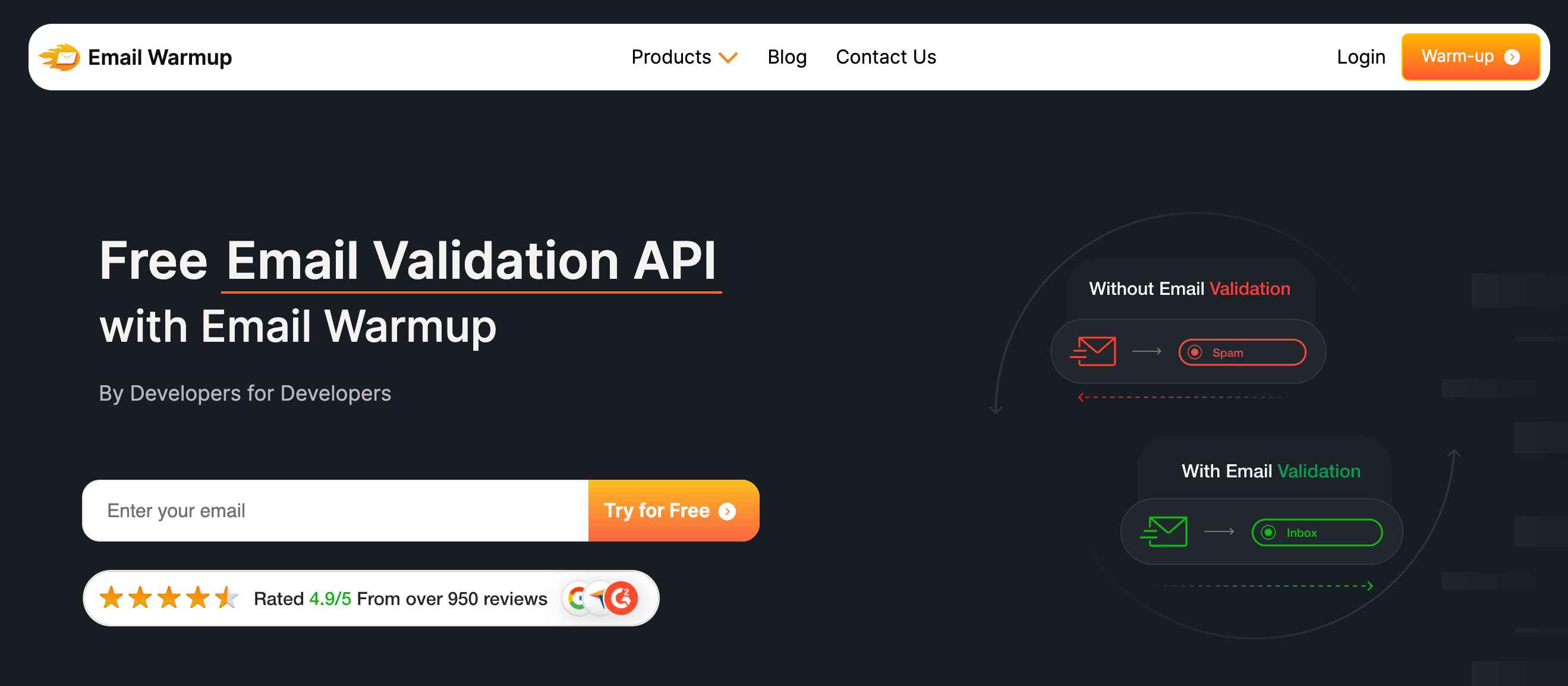
For teams seeking verification paired with deliverability infrastructure, EmailWarmup.com offers the email validation API, along with warmup and testing.
Key advantages
- SDKs in 8 languages
- 100 free credits for testing
- Real-time verification via REST/JSON API
- Blocks disposables and spam traps at capture
- Integrates with email warmup and email deliverability testing
The API fits naturally into workflows that already include warmup, verification, and sender reputation management within one ecosystem. Deliverability consultants are available for hands-on support.
Final verdict
DeBounce delivers exactly what it promises — accurate verification at budget-friendly pricing with non-expiring credits.
The 97.5% deliverability guarantee holds up, speed is fast, and high volumes process without friction.
The trade-off is 7-day data retention. Spam trap detection that isn’t quite premium-tier. Account creation requires a support contact rather than self-service.
For cold email teams prioritizing cost-effectiveness, DeBounce represents genuine value. For those needing maximum spam trap accuracy or longer retention, consider alternatives with more robust infrastructure.
Frequently asked questions
Here are some commonly asked questions about DeBounce:
DeBounce guarantees 97.5% deliverability — and user reports support this claim. One user documented bounce rates dropping from 21% to ~1% after implementation. Accuracy compares favorably to premium competitors at a fraction of the cost (which makes the value proposition compelling).
Seven days. Cleaned lists delete automatically after a week, so download promptly. Some users consider this the platform’s biggest limitation.
Primarily pricing. Users report nearly identical accuracy at roughly one-quarter the cost. DeBounce also offers non-expiring credits, while NeverBounce uses subscription pricing that compounds at scale.
DeBounce includes spam trap detection, but reviews note occasional gaps. For operations where spam trap accuracy is mission-critical, premium alternatives may justify the extra cost.