

Xverify is a legacy email verification and lead quality platform that has been operating since 2011. It offers bulk and real-time email verification, with additional address and phone validation capabilities. The platform checks syntax, domain validity, and mailbox existence, and applies fraud-protection measures to screen for temporary or disposable accounts.
From a deliverability consultant’s standpoint, Xverify sits in a difficult position. The pricing is competitive (starting at $0.01 per email), and the real-time API offers legitimate value for form-level validation.
But the accuracy track record is mixed — one G2 reviewer documented a 34% failure rate on standard US addresses, and the platform lacks spam trap detection and duplicate removal that most modern verifiers include by default.
The user experience (confusing onboarding, limited documentation) and inconsistent support (varying from “very responsive” to “non-existent”) raise additional concerns. With only 2 reviews on G2 (3.0/5 average) and no Trustpilot presence, independent validation is sparse.
This review evaluates:
- User experience and support reliability
- Who can work with Xverify’s limitations, and who cannot
- Accuracy and verification depth against current standards
- Pricing competitiveness and where cheap becomes costly
TLDR: Xverify at a glance
Here is a quick summary of where Xverify stands in the verification category.
| Category | Detail |
| Primary function | Email, phone, and address verification |
| Pricing model | Pay-as-you-go (per credit) |
| Starting price | $0.01 per email (up to 5,000) |
| Free tier | 100 free credits on signup |
| Standout feature | Multi-type validation (email, phone, address) |
| Biggest weakness | 34% accuracy failure rate reported on standard addresses |
| Best alternative | EmailWarmup.com’s email validation API |
| Overall rating | 2.4 / 5 |
Is Xverify worth the discount price?
Xverify’s pricing is among the lowest in the category. Credits scale from $0.01 per email (under 5,000) down to $0.005 per email (50,000-100,000). No setup fees, no minimums, pay-as-you-go — the structure is flexible and accessible.
But cheap verification that produces inaccurate results is worse than no verification at all.
If valid addresses are flagged as invalid (the 34% failure rate documented in the G2 review), you lose reachable contacts. If invalid addresses pass through (because spam-trap detection is absent), you risk blacklisting and sender reputation damage.
Additional pricing concerns:
- No clear refund policy (the dashboard links to a refund page with no information)
- No duplicate removal included (a standard feature elsewhere)
- Slower processing speeds compared to modern competitors
- No deliverability testing or diagnostics at any tier
The credit savings evaporate quickly when inaccurate results lead to higher bounce rates, reputation hits, or lost contacts that should have been kept.
What Xverify’s accuracy data reveals about verification risk
Xverify claims 98% accuracy. The limited user review data tells a different story — and the gaps in detection coverage add to the concern.
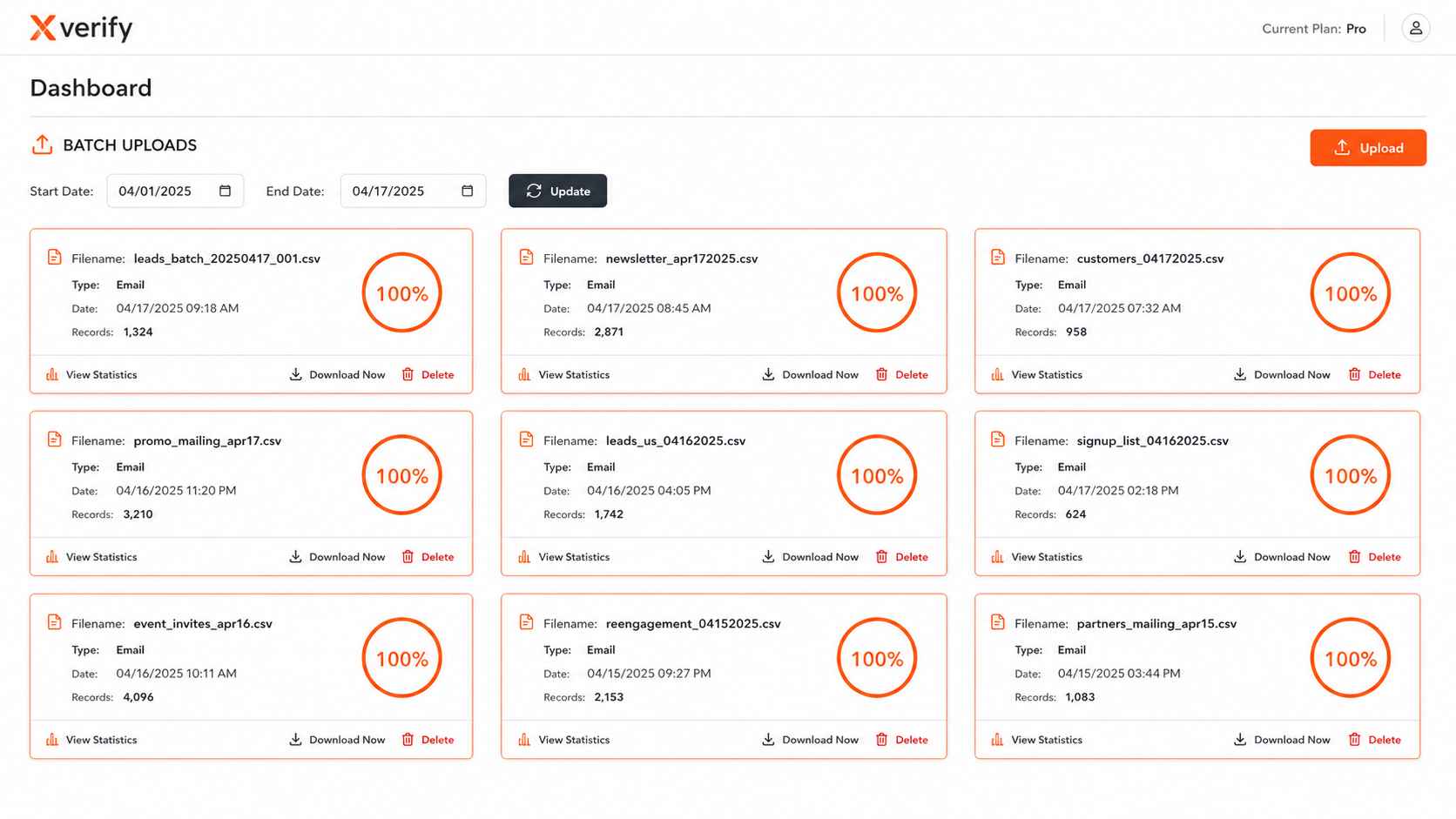
Accuracy problems
The most detailed G2 review describes testing 600+ US addresses (including known family member addresses) and finding a 34% failure rate — valid addresses incorrectly flagged as invalid.
If that rate holds across a production list, you are discarding one in three reachable contacts before ever sending a message.
Missing detection layers
Xverify does not detect spam traps — addresses planted by ISPs and blacklist operators to catch senders with poor list hygiene.
Sending to a spam trap can trigger immediate blacklisting and sustained reputation damage. For any sender managing lists older than a few months, this missing layer is a meaningful risk.
No duplicate removal
Most modern verifiers strip duplicates during the cleaning pass. Xverify does not, which means you pay credits to verify the same address multiple times if your list contains duplicates — a common occurrence in CRM and marketing databases.
Pros and cons of Xverify
Xverify’s low pricing and multi-type validation (email, phone, address) give it a narrow niche. The accuracy concerns, missing features, and support inconsistency limit where that niche ends, and risk begins.
Who should and shouldn’t use Xverify
Xverify’s limitations narrow its viable audience significantly. The low price is attractive, but the accuracy and feature gaps mean the cost savings can be illusory.
Who should use Xverify
- Very budget-constrained teams needing basic form-level email checks
- Businesses that also need phone and postal address validation in one tool
- Low-stakes use cases where occasional false negatives are acceptable
Who shouldn’t use Xverify
- Teams managing older lists where spam-trap detection is needed
- High-volume operations that need fast processing and reliable results
- Senders who depend on verification accuracy to protect domain reputation
- Anyone sending to enterprise or B2B lists where false positives waste the pipeline
Xverify scorecard for email operations teams
| Category | Score (out of 10) | Notes |
| Accuracy | 3 | 34% failure rate reported on standard addresses |
| Spam-trap detection | 1 | Not available |
| Processing speed | 4 | Slower than modern competitors |
| API quality | 5 | Real-time API available, limited documentation |
| Pricing | 7 | Among the cheapest in the category |
| Support reliability | 3 | Ranges from responsive to non-existent |
| Data security | 3 | No GDPR compliance info published |
| Overall value | 3 | Low cost undermined by accuracy and feature gaps |
How Xverify fits into a list cleaning workflow
Xverify operates at the verification layer — checking addresses before you send. It does not extend into deliverability testing, monitoring, or reputation management.
Bulk cleaning
Upload email lists for batch verification. Processing takes about 30 minutes for 10,000 business addresses (according to Xverify’s documentation), which is noticeably slower than competitors that process 100,000+ in under an hour.
Real-time validation
The API checks addresses at the point of entry (forms, signups, CRM integrations). Real-time validation prevents bad data from entering your system — and this remains Xverify’s strongest use case, assuming the accuracy issues are less severe for the specific domains you target.
Missing layers
No email list hygiene guidance, no deliverability diagnostics, no authentication checks, no warmup integration. Xverify cleans (with caveats) — it does not diagnose, fix, or monitor.
What happens after you stop using Xverify?
Verified data ages rapidly. Stopping Xverify means your lists begin decaying immediately.
- No ongoing monitoring or re-verification included
- Spam traps that were never detected remain in your lists
- No exportable intelligence or historical reporting carries over
- Credits may persist in your account, but no active protection continues
- False negatives (valid addresses flagged invalid) represent lost contacts you cannot recover
The most concerning post-usage risk is the undetected damage — spam traps that passed through verification because the detection layer was absent. Those addresses can trigger blacklisting months after the original verification.
A better alternative to Xverify | EmailWarmup.com
Xverify’s pricing is low, but the accuracy gaps and missing detection layers create a risk that affordable credits do not offset. EmailWarmup.com’s email validation API provides more reliable verification connected to a full deliverability platform.
EmailWarmup.com’s validation approach addresses Xverify’s specific weaknesses:
- REST/JSON API with SDKs in 8 languages
- Unlimited deliverability consultation to interpret results and guide fixes
- SOC 2 Type II and GDPR compliance (a gap Xverify does not publicly address)
- Real-time API verification that blocks disposable addresses, spam traps, and typos
- Connection to warmup, deliverability testing, authentication tools, and unlimited consultation
For teams where list accuracy directly affects sender reputation and revenue, the difference between a discount verifier and a deliverability-connected platform is the difference between saving credits and protecting your sending future.
Final verdict on Xverify
Xverify offers the lowest per-credit pricing in the verification category and the unique addition of phone and postal address checks. For very basic, low-stakes validation needs, the price-to-function ratio can work.
- Real-time API supports form-level validation
- 34% accuracy failure rate reported by a verified reviewer
- No spam-trap detection — a dangerous gap for list hygiene
- Support quality and onboarding experience are inconsistent
- No deliverability diagnostics, warmup, or consultation layer
- Cheapest per-credit pricing available in the category
If accuracy, spam-trap coverage, and support reliability are priorities (and for anyone protecting sender reputation, they should be), Xverify’s savings come with a risk that outweighs the discount. The cost of a missed spam trap or a blacklist hit dwarfs the savings on verification credits.
Frequently asked questions about Xverify
Here are the questions senders commonly ask before choosing Xverify:
Xverify claims 98% accuracy, but one verified G2 review documented a 34% failure rate on standard US addresses. The gap between the claimed and reported accuracy is significant, and the limited review base makes independent validation difficult.
No. Xverify does not include spam-trap detection. For senders managing older lists or lists built from multiple sources, this missing layer creates real blacklisting risk.
Xverify does not publish GDPR compliance information on its website. The company mentions Privacy Shield certification, which is not the same as GDPR compliance. Teams handling EU contact data should verify compliance directly before uploading lists.
Modern verifiers (like EmailWarmup.com’s email validation API) include spam-trap detection, duplicate removal, GDPR compliance, and connection to broader deliverability tooling. Xverify’s feature set reflects an earlier era of verification — basic checks at low cost, without the detection depth current standards demand.