
Verifalia approaches email verification differently from most competitors.
The platform offers three verification quality levels (Standard, High, Extreme), each consuming different amounts of credits — an unusual model that gives senders control over how deeply each address is checked.
The developer-friendly architecture, support for international character sets, and pay-as-you-go credit system appeal to technically oriented teams.
G2 has only 2 reviews (4.5/5), which makes independent validation thin. A hands-on test by Sparkle (597 emails) returned 64% Deliverable, 25% Risky, 10% Undeliverable, and 1% Unknown — with real-world accuracy estimated at 93-95%, somewhat below the platform’s own claims. Bouncer’s review of Verifalia notes 92% accuracy in a third-party comparison, placing it third among tested verifiers.
The credit system introduces a hidden complexity that deserves attention. Free daily credits expire at midnight (use them or lose them), and higher quality levels consume 3x or 9x more credits per verification.
Teams that do not plan their verification cadence carefully can end up paying substantially more than the sticker pricing suggests.
In this review, we’ll be exploring:
- The credit pricing structure and where costs escalate
- Accuracy from independent testing and user feedback
- How Verifalia’s multi-quality verification model works in practice
- Where the developer-focused approach fits in a deliverability strategy
TLDR: Verifalia at a glance
Here is a quick summary of what Verifalia offers and where it fits.
| Category | Detail |
| What it is | Email verification platform with multi-quality levels and developer-focused API |
| Best for | Developer teams needing fine-grained verification control and international email support |
| Deliverability impact | Indirect — reduces bounces but offers no authentication, reputation, or placement tools |
| Main limitation | Confusing credit system with daily expiration; limited independent validation (2 G2 reviews) |
| Best-fit user | Technical teams comfortable with API integration and credit-based pricing math |
| Alternative | Email validation API for real-time verification with deliverability consultation |
Does Verifalia’s credit pricing actually make sense?
Verifalia’s pricing looks straightforward until you dig into the quality tiers. Subscription plans provide daily credits that expire at midnight:
- Free — 25 daily credits
- Starter — $9/month (250 daily credits)
- Professional — $49/month (1,250 daily credits)
- Enterprise — $199/month (6,250 daily credits)
- Ultimate — $499/month (25,000 daily credits)
The catch is that higher verification quality levels consume more credits per address.
Standard quality uses 1 credit per verification. High-quality uses 3 credits (three verification passes). Extreme quality uses 9 credits (nine passes). A team running the Starter plan on High quality gets roughly 83 verifications per day — not 250. On Extreme quality, that drops to about 28.
Paid credit packs (which do not expire) are available separately, but the pricing varies by volume and is layered on top of the subscription. The result is a pricing model that requires careful math to forecast, particularly when verification depth varies by list.
Bouncer’s comparison noted that Verifalia’s free credits expire daily, meaning idle days waste allocated credits entirely. For teams with irregular verification needs (a batch before each campaign rather than daily cleaning), the subscription model creates systemic waste unless supplemented with non-expiring credit packs.
What Verifalia’s verification results reveal about accuracy
Independent testing and user feedback suggest solid (but not exceptional) accuracy, with the multi-quality model adding genuine depth at higher tiers.
Hands-on test results
A Sparkle test of 597 emails through Verifalia returned 64% Deliverable, 25% Risky, 10% Undeliverable, and 1% Unknown.
The reviewer estimated real-world accuracy at 93-95% — acceptable for most use cases, but not the “99%+” implied by the platform’s marketing. Bouncer’s comparison placed Verifalia at 92% accuracy in their test, ranking third among the verifiers evaluated.
Quality level tradeoffs
The multi-quality model is Verifalia’s most distinctive feature. Standard quality runs a single verification pass — fast but with the same accuracy limits as any SMTP-based check.
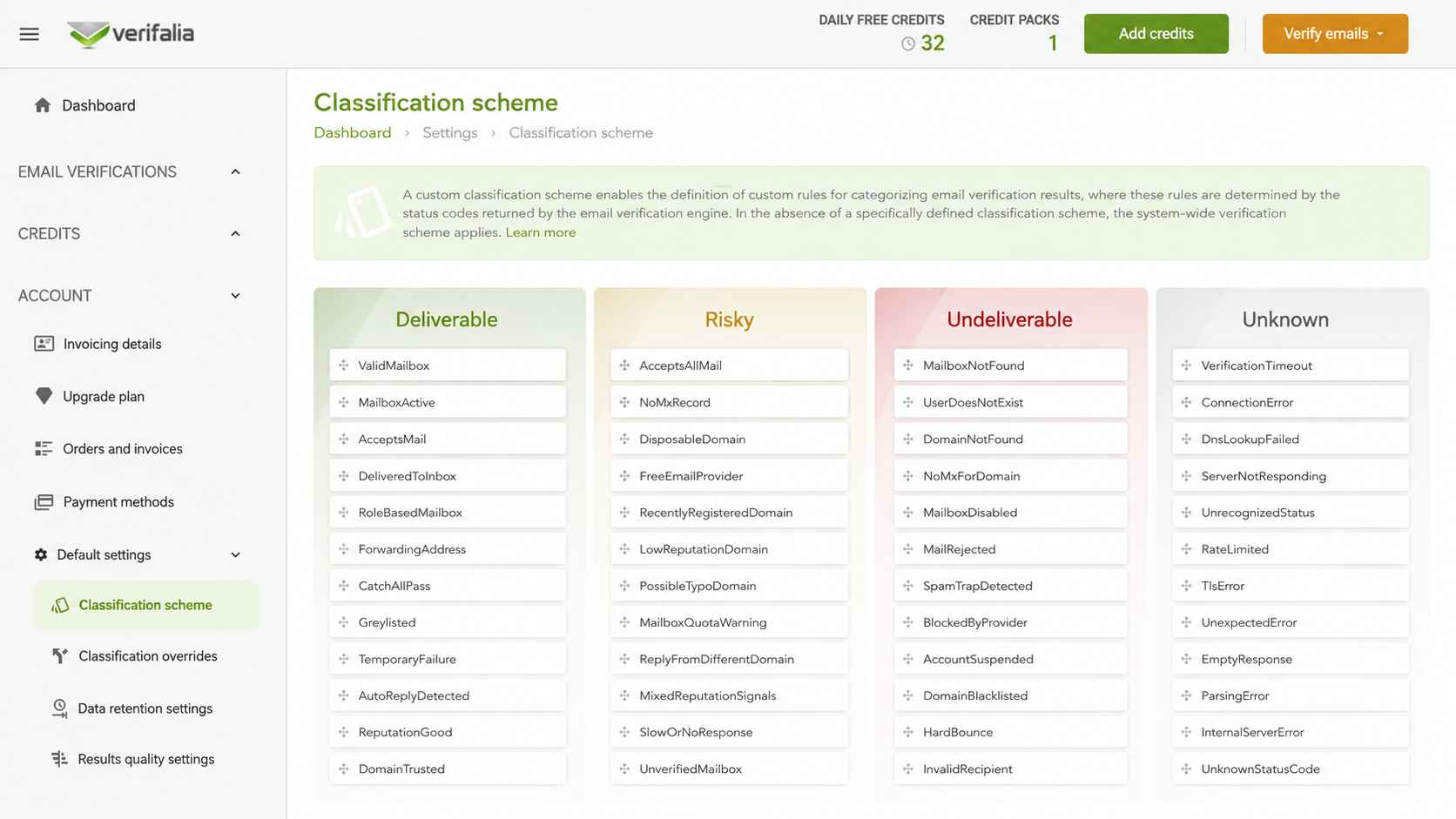
High quality runs three passes, which catch intermittent failures (addresses that time out on the first attempt but respond on the second). Extreme quality runs nine passes, providing the highest confidence at the cost of significantly more credits and processing time.
For most B2C email lists, Standard quality is sufficient. For B2B lists with catch-all domains or mail servers that delay responses, High or Extreme quality may reduce the “Risky” and “Unknown” buckets — at 3x or 9x the credit cost.
International support
Verifalia’s support for international character sets (Chinese, Arabic, Cyrillic) is a genuine differentiator. Most verification platforms silently mishandle or reject internationalized email addresses. For teams verifying lists with significant non-Latin representation, the feature matters.
Pros and cons of Verifalia
Verifalia offers verification control that most competitors lack. The pricing complexity and thin review footprint temper the recommendation.
- Three verification quality levels give senders control over accuracy vs. cost
- International email address support for non-Latin character sets
- Developer-friendly REST API with Google Sheets add-on and JS widget
- Handles bulk lists up to 100 MB (approximately 40 million records)
- Non-expiring paid credit packs available alongside subscriptions
- Free daily credits expire at midnight — unused credits are lost
- Higher quality levels consume 3x-9x more credits per verification
- Only 2 G2 reviews — minimal independent community validation
- Processing speed can slow significantly for large lists
- No deliverability tools beyond basic verification
Who should and shouldn’t use Verifalia
Verifalia fits technical teams that want verification granularity. The pricing complexity and limited community validation push less technical users toward simpler alternatives.
Who should use Verifalia
- Teams that need a JS widget or Google Sheets add-on for in-app verification
- Developer teams that need API integration with configurable verification depth
- Organizations verifying lists with significant international (non-Latin) email addresses
- Technical users who understand credit economics and can optimize quality level selection
Who shouldn’t use Verifalia
- Non-technical teams that want simple, predictable per-email pricing
- Budget-conscious senders who cannot absorb the daily credit expiration waste
- Anyone seeking a platform with strong community validation (2 G2 reviews is very thin)
Teams that need verification connected to deliverability testing, authentication, or reputation monitoring
Verifalia scorecard for email verification buyers
Here is how Verifalia rates across the dimensions that matter for verification-focused teams.
| Category | Rating | Notes |
| Verification control | ★★★★☆ | Multi-quality levels provide genuine depth — a unique differentiator |
| Accuracy | ★★★☆☆ | 92-95% in independent testing; solid but not class-leading |
| Pricing clarity | ★★☆☆☆ | Daily expiration, multi-tier credit consumption — confusing math |
| Developer experience | ★★★★☆ | Strong API, JS widget, Google Sheets add-on |
| Community validation | ★☆☆☆☆ | Only 2 G2 reviews — insufficient for confident evaluation |
| Deliverability breadth | ★★☆☆☆ | Verification only — no authentication, reputation, or placement tools |
How Verifalia fits into an email verification workflow
Verifalia works as a pre-send verification layer with configurable depth. The workflow is straightforward for technical teams but requires credit planning.
Upload and verification
Upload CSV, Excel, or plain text files through the dashboard, or paste lists directly. Select the quality level (Standard, High, or Extreme) before processing. Standard runs fastest and cheapest. High and Extreme increase accuracy at proportional credit and time costs.
Results classification
Verifalia classifies results into Deliverable, Risky, Undeliverable, and Unknown. The Risky category primarily contains catch-all addresses — flagged for sender decision rather than automatic removal.
The classification model is clear and comparable to most verification tools (though less granular than EmailListVerify’s 18-category system).
API integration
The REST API supports real-time verification at signup forms and batch processing within automated workflows. SDKs are available for multiple languages, and the Google Sheets add-on enables non-developer verification workflows. The API documentation is well-maintained, though some G2 reviewers note a learning curve for initial setup.
What happens after you stop using Verifalia?
Subscription daily credits stop accruing. Non-expiring credit packs remain available if previously purchased.
Downloaded verification results stay usable, but verified status degrades over time as email addresses change, employees leave companies, and domains reconfigure.
Verifalia provides no ongoing monitoring, no list hygiene automation, and no alerts for degrading list quality. Teams using Verifalia for periodic verification will need to re-verify before each campaign — a responsibility that the platform provides no assistance with after cancellation.
A better alternative to Verifalia | EmailWarmup.com
Verifalia verifies addresses with configurable depth. EmailWarmup.com verifies addresses and connects that verification to the deliverability infrastructure that determines whether your emails actually reach the inbox.
EmailWarmup.com’s email validation API provides real-time verification with:
- Format, domain, mailbox, and risk signal checks in a single pass
- Unlimited deliverability consultation, so verification results become actionable fixes
- Disposable address, spam trap, and typo blocking before contacts enter your CRM
- Connection to a 360° deliverability audit covering authentication, reputation, and infrastructure
Verifalia gives you verification at three quality levels. EmailWarmup.com gives you verification, diagnosis, and expert-guided remediation — without daily credit expiration or confusing tier math.
Final verdict on Verifalia
Verifalia is a technically thoughtful verification platform with genuinely useful features (multi-level quality, international support, a developer-friendly API). The verification quality is solid, and the configurable depth gives senders control that most competitors lack.
The limitations that temper the recommendation:
- Higher quality levels multiply costs 3x-9x per verification
- Only 2 G2 reviews provide insufficient community validation
- Daily credit expiration wastes unused allocation on idle days
- No authentication, reputation, or placement tools accompany verification
- Processing speed slows for larger lists, especially at higher quality levels
For technically oriented teams that want verification granularity and can navigate the credit math, Verifalia is a reasonable choice.
For teams that want simple pricing, broad community validation, and verification connected to deliverability infrastructure, simpler alternatives deliver more value with less friction.
Frequently asked questions about Verifalia
Here are the most common questions buyers ask when evaluating Verifalia.
Independent testing places Verifalia’s accuracy at 92-95%, depending on the quality level selected. Standard quality (single pass) produces results comparable to most SMTP-based verifiers. High and Extreme quality (3 and 9 passes) improve accuracy for edge cases, particularly addresses on servers that delay responses.
Subscription daily credits expire at midnight — unused credits from each day are lost. Separately purchased paid credit packs do not expire and can be used anytime. The distinction is important for teams with irregular verification schedules, where daily expiration creates waste.
Yes. Catch-all addresses are flagged as “Risky” rather than definitively classified. The Risky designation allows senders to decide whether to include catch-all contacts based on their risk tolerance. Higher quality levels may reduce the Risky bucket by running additional verification passes, but catch-all domains remain inherently difficult to verify definitively.
Verifalia offers more verification depth (multi-quality levels) and better international support. ZeroBounce provides broader features (email scoring, activity data, blacklist monitoring) alongside verification. NeverBounce offers simpler pricing and wider community validation. The choice depends on whether verification granularity or feature breadth matters more to your workflow.