
VerifiedEmail is one of the newest entrants in the email verification space — founded in 2024 and positioning itself as the fastest, most affordable verification service available.
The marketing leans heavily on an AWS-inspired infrastructure model (scale on demand, pass the savings through) and a per-verification cost of roughly $0.007 per email at the entry paid tier.
The feature list is competitive for a new platform:
- Bulk list cleaning
- Real-time verification
- API access is included across every plan
- A website widget with reCAPTCHA integration
- Continuous re-verification (daily monitoring for list decay)
The credits never expire, and re-verifications within 24 hours are free — both thoughtful design decisions.
However, the challenge is trust. VerifiedEmail has zero reviews on G2, Capterra, Software Advice, and SourceForge. GetApp lists the product but shows no user feedback.
The only detailed “review” content is a GitHub Gist that reads like promotional copy (complete with discount codes and affiliate-style CTAs).
For a verification tool — a product you trust to protect sender reputation — the absence of independent validation is a meaningful gap. This review covers:
- The trust problem with zero independent reviews
- Where a new verifier fits (or does not) in a deliverability-conscious workflow
- A stronger alternative with established credibility and a deliverability infrastructure
- What VerifiedEmail claims to offer and how the feature set compares
- Pricing structure and where the economics work
TLDR: VerifiedEmail at a glance
Here is a quick summary of what VerifiedEmail claims to offer and the current state of validation.
| Category | Detail |
| What it is | Email verification and list cleaning platform (founded 2024) |
| Best for | Early adopters seeking aggressive pricing and continuous cleanup |
| Deliverability impact | Indirect — claims to reduce bounces; no independent accuracy validation exists |
| Main limitation | Zero reviews on G2, Capterra, Software Advice, or SourceForge — unproven |
| Best-fit user | Teams willing to pilot-test a new verifier alongside an established backup tool |
| Best alternative | Email validation API for real-time verification with deliverability consultation |
Is VerifiedEmail’s aggressive pricing real?
VerifiedEmail’s pricing is designed to undercut the market. The structure is transparent:
- Free — 200 credits (one-time, no credit card)
- Verify Once — from $7 for 1,000 emails (pay-as-you-go)
- Re-Verify Daily — from $7.20/month (annual billing) for continuous cleanup
- Enterprise (1M+) — custom pricing (the platform claims it will beat any competitor’s price)
Several design decisions differentiate the pricing model:
- Credits never expire (buy now, use whenever)
- No charge for duplicates or malformed email removal
- Re-verifications within 24 hours are free (useful for overlapping lists)
- No feature tiers — every plan includes all features
At roughly $0.007 per email on the entry paid plan, the per-verification cost sits near the bottom of the market. The “Continuous Cleanup” feature (daily re-verification that automatically handles temporarily unreachable addresses) has no direct equivalent at most competing platforms.
The pricing looks genuinely competitive. Whether the verification quality matches the pricing competitiveness is the unanswered question — a question that only independent testing and community feedback can resolve, and neither currently exists.
What can we actually verify about VerifiedEmail’s claims?
The core challenge with evaluating VerifiedEmail is the absence of independent evidence. The platform makes specific claims that deserve scrutiny.
Claimed verification pipeline
VerifiedEmail describes a multi-step process:
- Duplicate and malformed address removal (free, pre-verification)
- Domain health and mail server configuration checks
- Role and alias detection (sales@, support@, noreply@)
- Mailbox-level SMTP verification
- Proprietary deliverability scoring
The pipeline is reasonable and comparable to what established verifiers offer.
However, with zero independent tests or reviews, there is no way to confirm that the pipeline performs as described. VerifiedEmail’s own materials reference “99% accuracy” — a claim shared by most verification tools, and one that independent testing routinely challenges.
Continuous cleanup
The “Maintain” feature (daily re-verification with automatic handling of temporarily unreachable addresses) is genuinely useful in concept. Most verification tools provide point-in-time snapshots — verify once, then the data decays.
Continuous cleanup addresses the decay problem, which matters for teams maintaining large, long-lived contact databases. Whether the implementation delivers on the concept is unverified.
Integrations
VerifiedEmail lists integrations with HubSpot, Klaviyo, and Zapier, plus a REST API and webhooks. GetApp confirms the three integrations. The integration set is narrow compared to established verifiers (ZeroBounce offers 100+), but the Zapier connection extends compatibility to most SaaS tools indirectly.
Pros and cons of VerifiedEmail
VerifiedEmail’s feature set looks competitive on paper. The absence of independent validation is the primary risk factor.
- Aggressive per-verification pricing (~$0.007/email)
- Credits never expire — no subscription pressure
- Free duplicate/malformed removal and 24-hour re-verifications
- Continuous Cleanup feature for ongoing list maintenance
- GDPR, CCPA, and Privacy Shield compliance stated
- Zero reviews on G2, Capterra, Software Advice, or SourceForge
- Founded 2024 — no track record for long-term reliability
- Only 3 native integrations (HubSpot, Klaviyo, Zapier)
- No deliverability tools beyond verification
- Available “review” content reads as promotional rather than independent
Who should and shouldn’t use VerifiedEmail
VerifiedEmail’s fit depends entirely on risk tolerance. The pricing and features are attractive. The unproven track record is the counterweight.
Who should use VerifiedEmail
- Early adopters who are comfortable piloting new tools with small test batches
- Budget-sensitive senders attracted to non-expiring credits and aggressive pricing
- Teams that plan to cross-verify results against an established tool before committing
- Developers who want to test the API with the free 200-credit allocation before investing
Who shouldn’t use VerifiedEmail
- Anyone who treats “zero independent reviews” as a disqualifying risk signal
- Organizations that require proven accuracy validated by community reviews
- Teams where sender reputation damage from a single bad batch would be costly
Senders who need verification connected to authentication, reputation, or deliverability testing tools
VerifiedEmail scorecard for verification buyers
Here is how VerifiedEmail rates — with the caveat that several categories are unverifiable due to the absence of independent feedback.
| Category | Rating | Notes |
| Pricing value | ★★★★★ | Among the cheapest per-verification costs available |
| Feature completeness | ★★★★☆ | Continuous Cleanup and free re-verifications are genuine differentiators |
| Verified accuracy | ☆☆☆☆☆ | Zero independent tests or reviews — accuracy is unverifiable |
| Community trust | ★☆☆☆☆ | No reviews on any major platform; founded in 2024 |
| Deliverability breadth | ★★☆☆☆ | Verification only — no authentication, reputation, or placement tools |
| Integration depth | ★★☆☆☆ | 3 native integrations; Zapier extends reach but adds friction |
How VerifiedEmail fits into a verification workflow
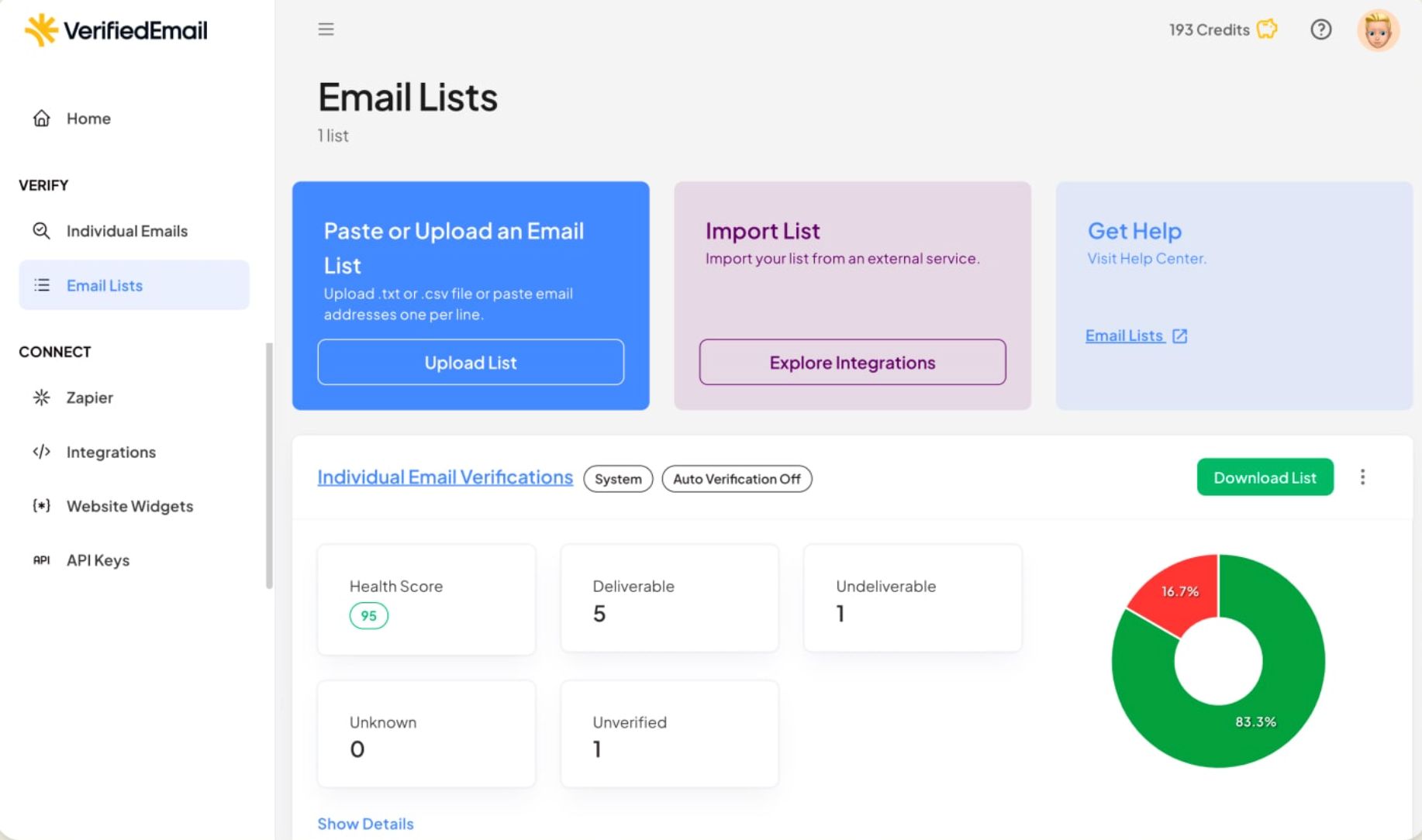
VerifiedEmail claims to support four workflows — Verify (real-time), Clean (bulk), Maintain (continuous), and Integrate (API/webhooks). The design is thoughtful and covers the main verification use cases.
Point-of-entry verification
The website widget (with reCAPTCHA) validates email addresses as users type them into forms. Real-time verification at signup prevents invalid addresses from entering your database.
The concept is sound and mirrors what established tools like ZeroBounce and NeverBounce offer — though without independent validation of accuracy or false-positive rates.
Bulk cleaning
Upload a list, remove duplicates and malformed addresses for free, verify the rest, and download segmented results. The workflow is standard across the industry. VerifiedEmail claims 100,000 emails verified in under 30 minutes — a competitive processing speed if accurate.
Continuous monitoring
The Continuous Cleanup feature automatically re-verifies lists daily and handles temporarily unreachable addresses (full mailboxes, intermittent server issues).
The feature addresses a real gap — list decay is the silent killer of email deliverability, and most verification tools offer no mechanism to detect addresses that go stale after initial verification.
What happens after you stop using VerifiedEmail?
Credits never expire, so unused allocations remain available after cancellation. Downloaded verification results stay usable but decay over time.
The Continuous Cleanup feature stops monitoring when the subscription ends, so list quality begins to degrade immediately without manual re-verification.
No monitoring, no alerting, and no list hygiene automation persists after cancellation. The Continuous Cleanup feature — VerifiedEmail’s most differentiated capability — only works while the subscription is active.
A better alternative to VerifiedEmail | EmailWarmup.com
VerifiedEmail offers promising features at aggressive pricing. EmailWarmup.com offers proven verification inside a deliverability system with established credibility.
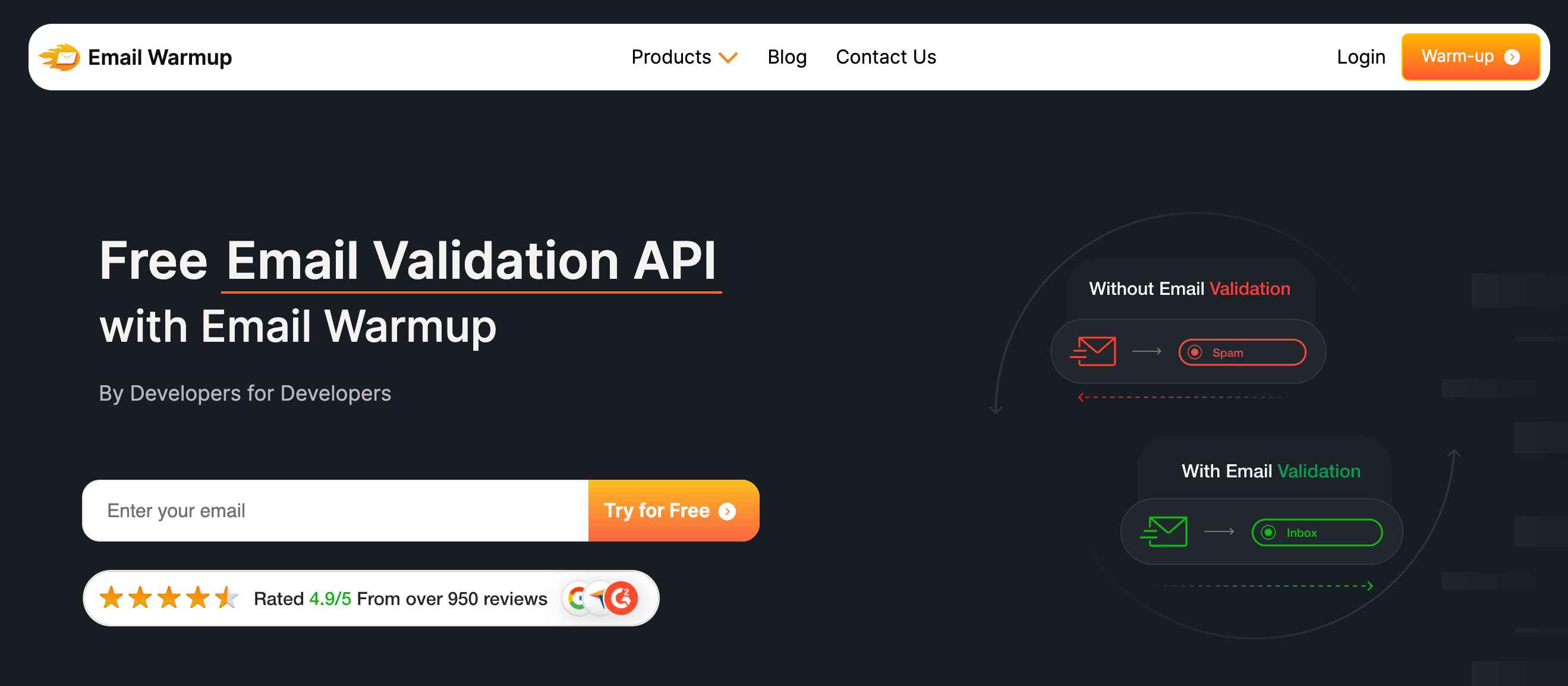
EmailWarmup.com’s email validation API provides real-time verification backed by:
- Disposable address, spam trap, and typo blocking
- Unlimited deliverability consultation with real experts — not chatbots
- Trusted by 1,000+ companies with documented case studies and results
- Format, domain, mailbox, and risk signal checks — with established accuracy
- A 360° deliverability audit that connects verification to authentication, reputation, and infrastructure
For teams that need verification they can trust — backed by community validation and connected to the broader deliverability system — EmailWarmup.com provides what VerifiedEmail’s features promise but cannot yet prove.
Final verdict on VerifiedEmail
VerifiedEmail brings competitive pricing, thoughtful features (non-expiring credits, free re-verifications, Continuous Cleanup), and a clean product design to the email verification market. For a platform founded in 2024, the feature set is surprisingly mature.
The risk that prevents a stronger recommendation:
- Only 3 native integrations limit workflow flexibility
- Founded in 2024 with no track record for reliability under stress
- Zero reviews on every major review platform — accuracy is unverifiable
- Available promotional content does not substitute for independent testing
- No authentication, reputation, or deliverability tools accompany verification
For early adopters willing to pilot-test alongside an established verifier, VerifiedEmail may turn out to be a strong value play.
For teams where a verification failure damages sender reputation, revenue, or customer relationships, the lack of proven accuracy makes the risk difficult to justify — regardless of how attractive the pricing looks.
Frequently asked questions about VerifiedEmail
Here are the most common questions buyers ask when evaluating VerifiedEmail
VerifiedEmail claims 99% accuracy, but zero independent reviews or tests validate the claim. The verification pipeline (syntax, domain, MX, SMTP, deliverability scoring) is comparable to established tools, but without community feedback, accuracy remains theoretical. Teams considering VerifiedEmail should run small pilot batches and compare results against a proven verifier before committing larger lists.
No. Credits purchased on VerifiedEmail never expire. Re-verifications within 24 hours are also free — meaning the same address checked twice in one day consumes only one credit. The credit model is one of the platform’s strongest pricing features.
Continuous Cleanup automatically re-verifies your email lists daily, handling temporarily unreachable addresses (full mailboxes, intermittent server failures) without manual intervention. The feature addresses the list decay problem that most point-in-time verification tools ignore. The concept is strong — but independent validation of its effectiveness does not yet exist.
ZeroBounce offers broader features (email scoring, activity data, blacklist monitoring), 100+ integrations, and extensive community validation (4.7/5 on G2 from 1,350+ reviews). VerifiedEmail offers lower per-email pricing and the Continuous Cleanup feature, but lacks any independent validation. For teams prioritizing proven reliability, ZeroBounce is the safer choice. For teams prioritizing cost and willing to accept early-adopter risk, VerifiedEmail may offer better economics.