

Validity Everest (formerly Return Path) is the enterprise standard for email deliverability monitoring — combining inbox placement testing across 70+ ISPs, deep sender reputation data, competitive intelligence, DMARC parsing, and a certification program that whitelists senders at Outlook, Yahoo, and AOL.
The platform serves dedicated deliverability teams at companies like Disney, Netflix, and Amazon, and no competing tool matches its data depth.
The catch is cost. Pricing starts around $1,000-$2,000/month for basic plans, climbing to $5,000-$10,000+ at enterprise tiers. Certification adds another $5,000-$15,000/year.
For senders below 500K emails/month, that investment rarely justifies the return — and several reviewers across G2 (4.2/5 from 189 reviews) and TrustRadius (10/10 from 51 reviews) confirm that Everest’s depth becomes overwhelming without a dedicated resource to act on it.
Here’s what this review covers
- Where the enterprise pricing creates genuine ROI, and where it doesn’t
- A stronger alternative for teams that need deliverability action, not just data
- Who actually needs Everest versus who’s overpaying for dashboards nobody checks
- How does Everest’s inbox placement and reputation monitoring compare to free alternatives
What does Everest actually offer?
Everest emerged from the merger of Return Path, BriteVerify, and 250ok — three legacy deliverability brands combined under Validity’s umbrella. The platform bundles five capabilities that, together, provide the most comprehensive deliverability view available anywhere.
| Capability | What it does | Competing free alternative |
| Inbox placement testing | Sends to seed panels across 70+ ISPs; shows inbox vs. spam vs. missing per provider | EmailWarmup.com deliverability test (unlimited, free) |
| Reputation monitoring | Sender Score, domain reputation, IP trends, blacklist monitoring (200+ lists) | Google Postmaster Tools + Microsoft SNDS |
| Design and content testing | Email rendering across 90+ clients/devices, dark mode preview, and content analysis | Litmus, Email on Acid |
| Competitive intelligence | Anonymized benchmarking against competitors’ inbox rates, cadence, and subject lines | No free equivalent |
| Certification program | Whitelist access at Outlook, Yahoo, AOL — images displayed by default, links enabled | No free equivalent |
Competitive intelligence and certification are Everest’s true differentiators (no other platform offers both). Inbox placement testing and reputation monitoring are available elsewhere at a fraction of the cost — sometimes free.
Does enterprise pricing deliver enterprise value?
Validity doesn’t publish pricing. Based on industry conversations and independent reviews, the estimated breakdown looks like this
| Tier | Monthly cost | Includes |
| Basic | $1,000-$2,000 | Inbox testing, reputation monitoring |
| Professional | $2,000-$4,000 | + Competitive intel, advanced analytics |
| Enterprise | $5,000-$10,000+ | + Multiple domains, API access, dedicated support |
| Certification | +$5,000-$15,000/year | ISP whitelist participation |
A Mailflow Authority review estimates total annual spend at $15K-$50K, depending on features and volume — a budget that only makes sense when marginal deliverability improvements translate directly to significant revenue.
For a retailer sending 5M emails/month, where a 2% inbox placement improvement equals thousands of additional conversions, the math works. For a SaaS company sending 200K/month, the same improvement might be worth $200 — making Everest a very expensive dashboard.
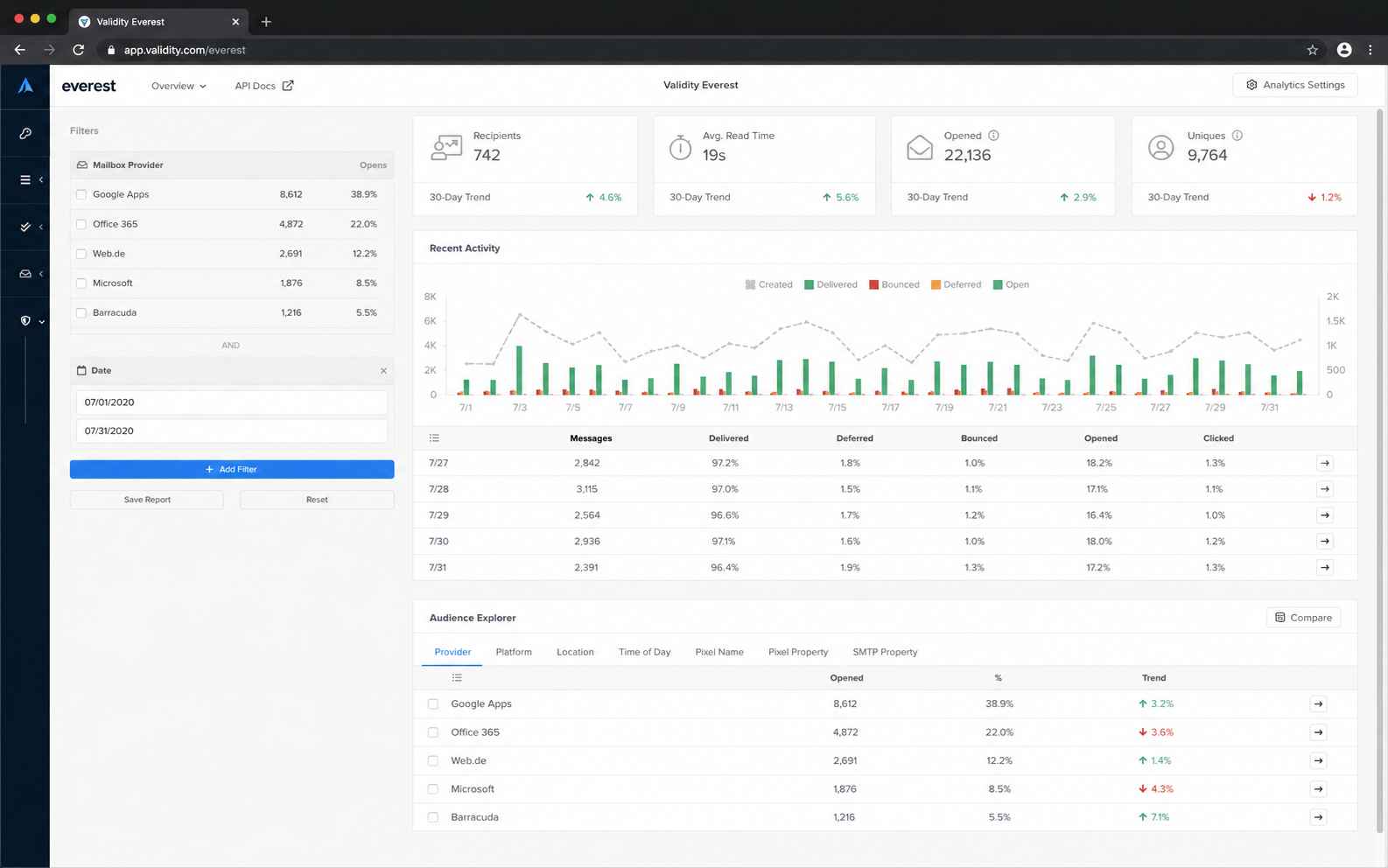
One G2 reviewer captured the risk perfectly (paraphrased) — “I’ve seen companies buy Everest and barely use it. Expensive dashboards nobody checks.” Before committing, the real question is whether someone on your team will act on the data weekly. If not, simpler tools provide 80% of the value at 10% of the cost.
How strong is Everest’s inbox placement testing?
Inbox placement testing is Everest’s core feature, and it genuinely outperforms alternatives on depth and provider coverage.
Seed panel coverage
Everest tests across 70+ ISPs — including corporate filters like Barracuda, Proofpoint, and Mimecast that simpler tools (GlockApps, Mail-Tester) cannot reach. For enterprise senders delivering to B2B inboxes behind corporate gateways, the corporate filter visibility is a genuine differentiator.
Historical trend analysis
Unlike point-in-time tools (which give you a snapshot per test), Everest tracks placement trends over months and years. Deliverability drift — the slow decline in inbox rates that happens when reputation erodes gradually — shows up clearly in trend data, but remains invisible in snapshot testing. Enterprise teams use trend analysis to catch problems before they become crises.
What does the certification program actually deliver?
Validity Certification (formerly Return Path Certification) is a paid whitelist program with tangible benefits at participating ISPs
- Links enabled by default
- Bypass spam filters at Outlook, Yahoo, and AOL
- Higher trust signals that influence filtering decisions
- Images display by default (instead of requiring recipient opt-in)
The certification requires passing quarterly audits, maintaining deliverability standards, and paying annual fees of roughly $5,000-$15,000, depending on volume.
A Mailflow Authority practitioner recommends certification specifically for senders above 1M/month who cannot afford any inbox friction — the ROI is clearer for transactional senders (receipts, confirmations, password resets) than for marketing email, where recipient engagement drives filtering more than whitelist status.
No competing platform offers an equivalent certification path (making Everest the only route to ISP-level whitelisting for senders who qualify).
Pros and cons of Validity Everest
Everest’s strengths are data depth and enterprise credibility. The weaknesses are cost, complexity, and the gap between monitoring and action.
- Deepest inbox placement data available — 70+ ISPs including corporate filters
- Competitive intelligence with no free equivalent
- Certification program provides ISP-level whitelist access
- Historical trend analysis catches deliverability drift early
- G2 rating of 4.2/5 from 189 reviews; TrustRadius 10/10 from 51 reviews
- Pricing starts at $1,000/month with no self-serve option
- Sales-gated onboarding with 1-2 week provisioning
- Overwhelming for teams without dedicated deliverability resources
- Monitors and diagnoses but does not fix deliverability problems
- 80% of senders can get sufficient monitoring from GlockApps or free tools
Who should (and shouldn’t) use Everest?
Everest’s fit narrows to organizations where the investment connects directly to revenue-impacting deliverability decisions.
Good fit
- Enterprise email operations sending 1M+ emails/month with dedicated deliverability staff
- Regulated industries (finance, healthcare) need audit trails and compliance documentation
- Organizations pursuing Sender Certification for whitelist benefits at Outlook, Yahoo, and AOL
- Agencies managing multiple high-volume clients who need shared dashboards and benchmarking
Poor fit
- Senders below 500K/month, where the cost-per-insight ratio is unsustainable
- Teams without a dedicated person to review the Everest data weekly and act on findings
- Startups and SMBs that would be better served by Google Postmaster Tools + Microsoft SNDS
- Anyone who needs fixing alongside monitoring — Everest identifies problems but does not remediate them
Everest scorecard for deliverability teams
| Category | Rating | Notes |
| Data depth | ★★★★★ | Unmatched — 70+ ISPs, corporate filters, competitive intel |
| Certification value | ★★★★☆ | Real whitelist benefits at participating ISPs |
| Pricing accessibility | ★☆☆☆☆ | $1,000+/month with no published tiers or self-serve |
| Actionability | ★★★☆☆ | Monitors and diagnoses, but does not implement fixes |
| Ease of adoption | ★★☆☆☆ | 1-2 weeks onboarding; full value takes months to unlock |
| Mid-market fit | ★☆☆☆☆ | Prohibitive for senders below 500K/month |
What happens after you stop using Everest?
Cancellation removes access to inbox placement trend data, reputation monitoring dashboards, seed panel testing, and competitive intelligence. Historical data remains within Validity’s systems and does not export with you.
Sender Certification also lapses — whitelist benefits at participating ISPs stop, which can produce an immediate (and noticeable) drop in inbox rates at Outlook and Yahoo for high-volume senders. Teams leaving Everest should plan for a transition period where placement metrics may decline before stabilizing under a new monitoring approach.
The deliverability knowledge gained from Everest dashboards remains useful, but continuous monitoring and trend visibility are lost entirely.
A better alternative to Validity Everest | EmailWarmup.com
Everest monitors deliverability at enterprise depth. EmailWarmup.com monitors deliverability and provides the tools and expertise to fix what the monitoring reveals — without enterprise pricing.
EmailWarmup.com provides
- Unlimited deliverability testing across 50+ providers with no credit caps or subscription fees
- A 360° deliverability audit that surfaces every issue hurting inbox placement
- Blacklist monitoring and remediation when listings occur
- Authentication setup and validation for SPF, DKIM, and DMARC
- Unlimited deliverability consultation from real experts — not just dashboards
Everest tells you where your emails land and why. EmailWarmup.com tells you where they land, diagnoses why, and gives you the guided path to fix every issue — at a fraction of the enterprise price.
Final verdict on Validity Everest
Everest earned its reputation as the gold standard for enterprise deliverability monitoring.
The inbox placement data is unmatched, the certification program provides real whitelist value, and the competitive intelligence has no free equivalent.
The boundaries are equally clear
- $1,000-$10,000+/month pricing excludes most mid-market senders
- 80% of senders get sufficient monitoring from tools that cost 10% as much
- Teams without dedicated deliverability resources will underuse the platform
- Monitoring without remediation creates expensive visibility into problems you still have to fix elsewhere
For enterprise operations with the volume, budget, and headcount to act on deep deliverability data, Everest delivers genuine value. For everyone else, the investment buys impressive dashboards — but dashboards alone don’t move emails from spam to inbox.
Frequently asked questions about Validity Everest
Here are some commonly asked questions about Validy Everest:
Pricing is not publicly listed. Based on industry sources, basic plans start around $1,000-$2,000/month, professional tiers run $2,000-$4,000/month, and enterprise plans with full features reach $5,000-$10,000+/month. Sender Certification adds $5,000-$15,000/year separately. All pricing requires a sales conversation.
Everest is the rebranded Return Path platform, now under Validity’s umbrella after the 2019 acquisition. The core technology (inbox placement testing, seed panel methodology, reputation monitoring) carried over, combined with BriteVerify (validation) and 250ok (analytics) into an integrated platform.
No. Everest monitors and diagnoses deliverability issues — inbox placement, reputation trends, blacklist status, and authentication gaps. Fixing the underlying problems (updating DNS records, repairing domain reputation, adjusting sending patterns) requires action outside the platform. Enterprise plans include dedicated customer success managers who can advise, but implementation remains the sender’s responsibility.
Is Everest worth it for small senders?
For senders below 500K emails/month, Everest’s cost rarely justifies the return. Free tools like Google Postmaster Tools and Microsoft SNDS provide sufficient reputation visibility, and EmailWarmup.com’s free deliverability test covers inbox placement across 50+ providers. Everest’s value emerges at enterprise scale where marginal placement improvements translate to meaningful revenue.