

SendForensics positions itself as a deliverability analytics and testing platform — one that predicts inbox placement issues before you press send. It analyzes message content, authentication status, sender reputation, and infrastructure signals to surface problems that could trigger spam filters or hurt placement.
The concept is sound. Most deliverability issues show symptoms before they cause damage, and catching them at the pre-send stage saves time, reputation, and revenue.
From a consultant’s perspective, predictive diagnostics fill a real gap — especially for marketing operations teams running complex programs across multiple ESPs.
Where SendForensics gets harder to evaluate is its market presence. The platform operates in a niche between spam checkers and full deliverability suites, with limited public review data and opaque pricing.
That makes it difficult to assess value independently, and it raises questions about whether the tool delivers enough depth to justify a dedicated budget.
This review covers:
- Pricing transparency and value signals
- Whether SendForensics improves inbox placement outcomes
- How its analytics approach compares to standard deliverability testing
- Who benefits and who needs more than pre-send analysis
TLDR: SendForensics at a glance
Here is a quick overview of where SendForensics fits in the deliverability testing category.
| Category | Detail |
| Primary function | Pre-send deliverability analytics and diagnostics |
| Pricing model | Not publicly listed |
| Free tier | Not confirmed |
| Standout feature | Predictive inbox placement scoring before sending |
| Biggest weakness | No remediation tools, warmup, or consultation |
| Best alternative | EmailWarmup.com’s email deliverability test |
| Overall rating | 3.0 / 5 |
Is SendForensics worth the investment?
SendForensics does not publish pricing publicly, which makes evaluating cost-to-value difficult before you engage their sales team.
For deliverability consultants advising clients on tool selection, opaque pricing is a friction point — it signals either enterprise-only positioning or a lack of standardized plans.
The platform’s value proposition centers on catching deliverability issues before they cause damage. That is worth paying for when your sending volume and revenue exposure justify a dedicated diagnostic layer.
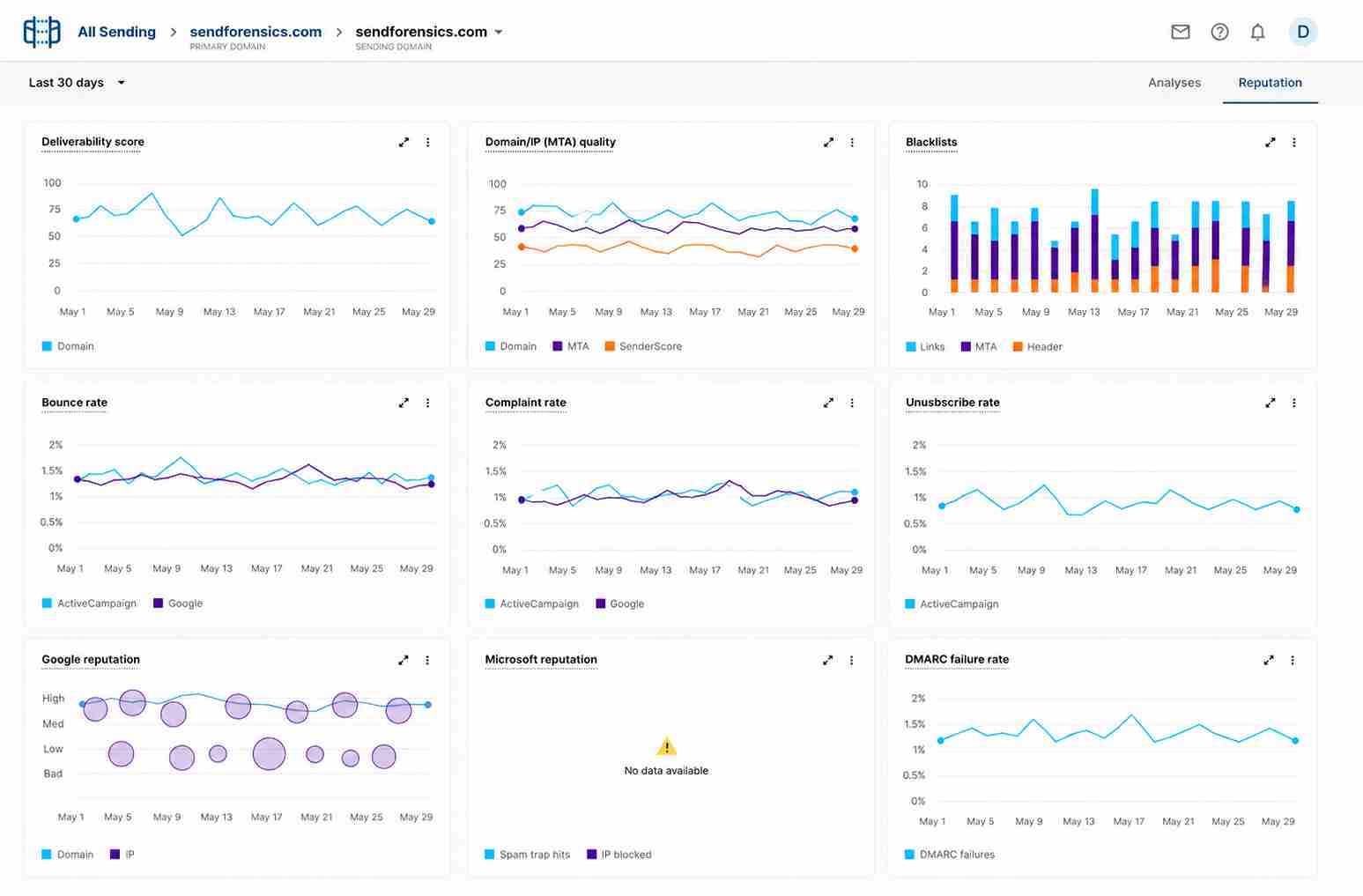
For high-volume marketing operations teams sending millions of emails monthly across platforms like Salesforce, Marketo, or HubSpot, pre-send analysis can prevent costly placement failures.
The value erodes when:
- You need ongoing inbox placement monitoring (not just pre-send)
- Your team lacks the expertise to act on diagnostic results without guidance
- You need warmup, authentication setup, or reputation repair alongside testing
Pre-send analytics are one layer of deliverability management. If SendForensics is the only deliverability tool in your stack, you are likely leaving gaps.
What SendForensics’s diagnostic approach reveals about deliverability
SendForensics takes a different approach than standard email deliverability testing tools.
Rather than sending a test email to a seed list and reporting where it lands, the platform analyzes message components predictively — scoring content risk, authentication health, and reputation signals before the email goes out.
Content analysis
The platform evaluates message structure, copy patterns, and content signals against known spam filter triggers. For teams sending templated campaigns at scale, catching content issues before launch prevents batch-wide spam placement.
Authentication checks
SendForensics inspects SPF, DKIM, and DMARC configuration as part of its diagnostic. Authentication failures are one of the most common (and most preventable) causes of poor deliverability, and pre-send detection prevents avoidable damage.
Reputation signals
The platform factors in sender reputation indicators that affect how mailbox providers treat your messages. For teams with damaged or uncertain domain reputation, this visibility is useful — though it does not fix the underlying issues.
Pros and cons of SendForensics
SendForensics fills a useful gap between basic spam checkers and full deliverability platforms. The tradeoff is that it diagnoses without treating — you get the analysis but must solve problems elsewhere.
Who should and shouldn’t use SendForensics
SendForensics fits teams that already manage deliverability infrastructure and need an additional diagnostic layer — not teams looking for a complete solution.
Who should use SendForensics
- Marketing ops teams with high send volumes who need pre-send quality checks
- Organizations already running authentication and reputation management separately
- Teams using multiple ESPs that need cross-platform content diagnostics
Who shouldn’t use SendForensics
- Teams needing ongoing inbox placement monitoring after sends
- Senders without existing authentication and warmup infrastructure
- Organizations that need a deliverability consultant or remediation guidance
- Small senders where a free email spam checker covers the diagnostic need
SendForensics scorecard for marketing operations
| Category | Score (out of 10) | Notes |
| Pre-send diagnostics | 7 | Multi-factor analysis is the core strength |
| Post-send monitoring | 3 | Limited ongoing visibility |
| Authentication support | 5 | Checks present, but no fix-it tools |
| Pricing transparency | 2 | Not publicly listed |
| Remediation depth | 2 | Diagnoses without treating |
| Ease of evaluation | 3 | Hard to assess without sales engagement |
| Overall value | 4 | Useful layer, but narrow scope |
How SendForensics fits into a deliverability workflow
SendForensics sits at the pre-send stage — after content is drafted and before the campaign launches. It does not extend into post-send monitoring, reputation repair, or infrastructure management.
Campaign prep
Run your email through SendForensics before launch.
The platform scores content, checks authentication, and flags reputation risks. For teams sending at high volume, this prevents batch-level spam placement that would otherwise require post-mortem recovery.
Result interpretation
The diagnostic output tells you what might cause problems. Acting on those results requires separate tools — authentication configuration, email list hygiene processes, reputation warming, or content revision.
Missing stages
There is no email warmup, no list verification, no blacklist monitoring, and no consultation support. SendForensics is a diagnostic instrument, not a treatment plan.
What happens after you stop using SendForensics?
Pre-send analytics do not create lasting infrastructure changes. When you stop using SendForensics, you lose the diagnostic layer — but nothing degrades because the tool did not change your sending environment.
- No reputation was built or maintained by the tool itself
- Authentication gaps identified during analysis still need separate fixes
- Content improvements made based on diagnostics persist in your templates
- The diagnostic value was per-campaign, not cumulative
The risk is not dependency — it is that you lose visibility into pre-send issues that might otherwise catch problems before they reach production.
A better alternative to SendForensics | EmailWarmup.com
SendForensics diagnoses, but it does not fix. EmailWarmup.com starts with a 360° audit that surfaces every issue hurting inbox placement, then provides the tools and expert guidance to address each one.
Where SendForensics stops at pre-send scoring, EmailWarmup.com covers:
- Unlimited deliverability consultation with real experts
- Email spam checker for real-time pre-send diagnostics
- SPF, DKIM, and DMARC validation and generation tools
- Unlimited email deliverability testing across 50+ providers
- Personalized warmup calibrated to your actual sending patterns
For teams that need analysis and the ability to act on what they find — with expert guidance at every step — EmailWarmup.com replaces the gap between seeing problems and fixing them.
Final verdict on SendForensics
SendForensics fills a legitimate niche — pre-send deliverability analytics that go deeper than basic spam scoring. For marketing operations teams with the expertise and infrastructure to act on diagnostic results, it adds a useful layer.
- No public pricing limits independent evaluation
- No remediation tools, warmup, or expert support included
- Limited third-party reviews make independent validation difficult
- Predictive analysis catches content, auth, and reputation issues before sends
- Narrow scope means it supplements a deliverability stack rather than replacing one
If your deliverability infrastructure is already mature and you need a pre-send quality gate, SendForensics can serve that role. If you need a platform that diagnoses, fixes, and monitors deliverability as a system, it falls short.
Frequently asked questions about SendForensics
Here are common questions buyers ask before choosing SendForensics:
SendForensics identifies issues that may cause poor placement, but it does not fix them. Inbox placement improvements depend on acting on the diagnostics — fixing authentication, adjusting content, cleaning lists, and managing reputation separately.
SendForensics goes beyond spam score checks by analyzing authentication, reputation, and infrastructure signals alongside content. A basic spam checker tests content against filters; SendForensics attempts to predict placement outcomes from multiple factors.
For low-volume senders, free tools like EmailWarmup.com’s email spam checker or deliverability test cover the diagnostic basics. SendForensics is positioned for teams where the cost of a placement failure justifies dedicated pre-send analytics.
No. SendForensics is a diagnostic layer, not a deliverability platform. It does not offer warmup, ongoing monitoring, authentication management, or consultation. Teams with active deliverability problems need tools that both diagnose and fix.