
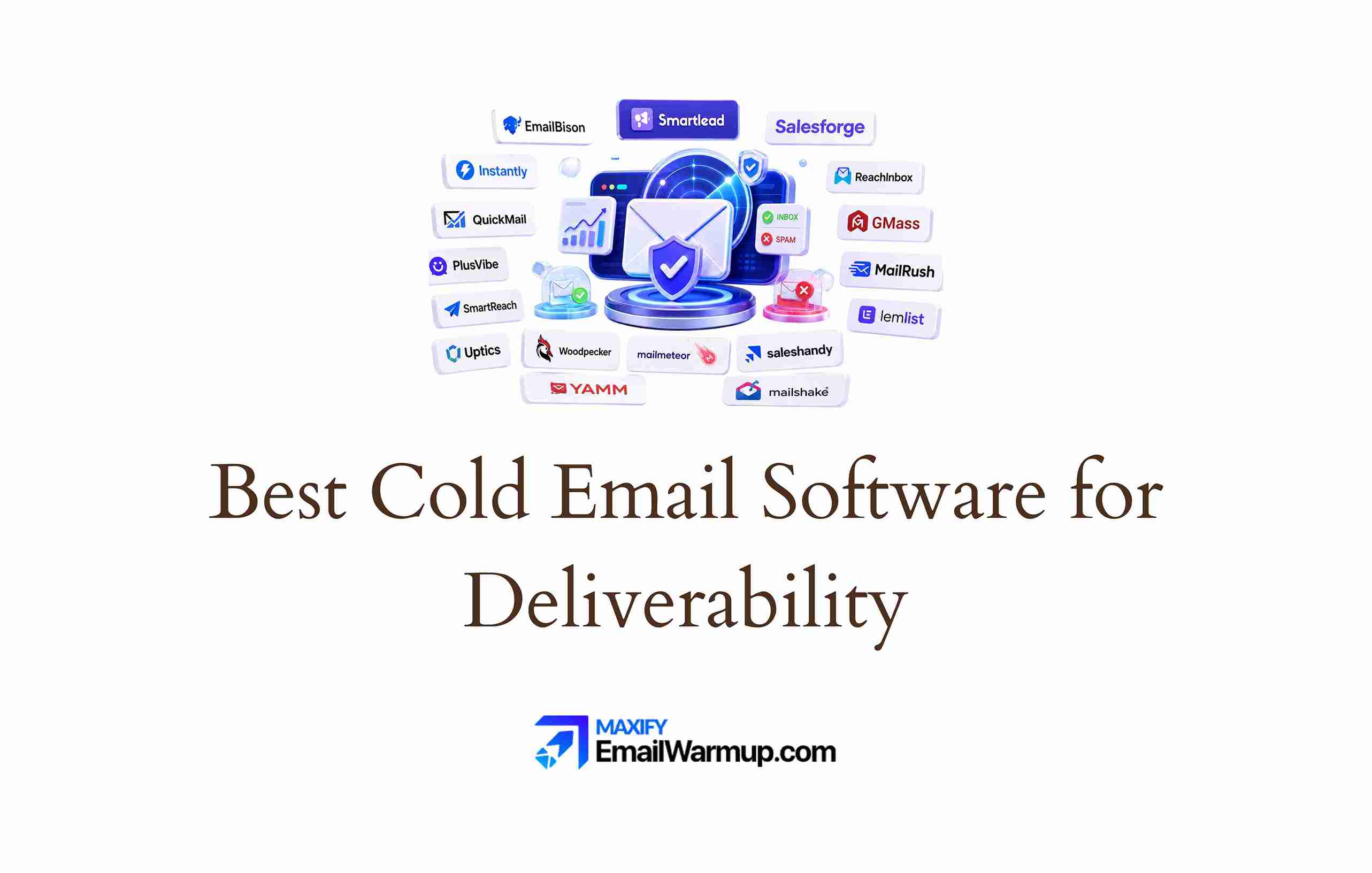
Cold email software is not a monolith. Some platforms are full infrastructure engines with private IPs and isolated warmup pools. Others are Chrome extensions bolted onto Gmail’s native API.
The deliverability gap between the best and worst cold email tools in our testing was 39.3 percentage points, the difference between consistently landing in the primary inbox and having nearly half your outreach disappear into spam folders or get rejected outright.
We ran structured inbox placement testing across 17 cold email platforms over a 14-day window, tracking where emails actually landed: primary inbox, promotions tab, spam folder, or blocked entirely.
The results cut through vendor marketing and expose which cold email sequencers, outbound email platforms, and Gmail-based tools actually protect your sender reputation at scale.
- 11 of the 17 cold email and Gmail-based platforms achieved primary inbox placement rates above 80%
- The top-performing cold email tool hit a 91.4% deliverability rate, while the lowest scored 52.1%
- Platforms with stronger dedicated infrastructure outperformed lighter shared-inbox sending tools by a clear margin
- Authentication pass rates ranged from 93.2% to 99.8% across the tested cold email platforms
- Gmail-based cold email tools showed strong IP trust but meaningful volume limits compared with dedicated outbound platforms
- Lower-ranked platforms struggled most with spam placement, inbox consistency, and infrastructure depth
- Warmup quality varied widely, with some tools relying on generic patterns that do not match real campaign behavior
- Misconfigured DMARC records were the most common authentication failure point
How did we run this test?
Modern cold email deliverability cannot be measured by open rates alone. Security scanners inflate opens artificially, and Mail Privacy Protection filters obscure real engagement data.
To produce numbers that reflect actual placement behavior, we built a multi-layer diagnostic protocol that combines seed-list testing with infrastructure audits, authentication verification, and behavioral sending analysis.
The testing protocol ran across a standardized 14-day tracking window for each platform. Every cold email tool was provisioned with identical DNS configurations, the same SPF, DKIM, and DMARC records, and the same sending copy.
Domains used across all tests were aged a minimum of 90 days with completed warmup cycles before any live sends began. The goal was to isolate the platform’s contribution to deliverability from every other variable.
Each platform was evaluated against six diagnostic criteria, applied identically and scored using the same thresholds. The process moved from infrastructure verification through live placement measurement, with each stage feeding data into the final deliverability rate and risk assessment.
SPF, DKIM, and DMARC alignment verified across all receiving servers
HTML structure, image ratios, URL health, and copy pattern analysis
Global RBL checks, Postmaster scores, and shared-range block audits
Campaigns sent to consumer and enterprise seed inboxes across Gmail, Outlook, and Yahoo
1,200-contact bounce tests measuring list-cleaning API accuracy
Ramp-up stability, throttling behavior, and rotation pattern monitoring
The primary metric across all platforms is the deliverability rate, the percentage of sent messages that reached the primary inbox, not promotions, not spam, and not blocked. We also tracked three secondary metrics.
| Metric | Definition |
| Spam placement rate | Percentage of messages landing in spam or junk folders. |
| Authentication pass rate | Percentage of messages passing full SPF, DKIM, and DMARC validation at the receiving server. |
| Infrastructure maturity score (1–10) | A composite score based on IP isolation, sending architecture, domain management, and warmup quality. |
What do the industry benchmarks look like right now?
Before getting into individual platform results, it helps to understand where the thresholds sit in 2026.
The email deliverability environment has shifted considerably since Google and Yahoo introduced stricter bulk sender requirements in February 2024, Microsoft followed in May 2025, and La Poste added enforcement in September 2025.
Non-compliant outbound connections now face throttling, spam routing, or outright rejection, not just soft filtering.
The spam complaint rate threshold is the number most cold email operators get wrong. Google’s public guidance sets the maximum at 0.3%, but the real target for sustained deliverability is below 0.1%.
At 0.3%, automated reputation systems have already begun suppressing your domain. The damage is done before you see it in Postmaster Tools. Meanwhile, bounce rates above 2% signal purchased or unverified contact lists, triggering both IP-level and domain-level authority drops.
The conservative sending cap of 30 cold emails per inbox per day comes from operational experience, not provider documentation.
Some operators push 40–50 safely, but for teams managing more than 10 sending domains, 30 provides the margin needed to avoid tripping volume-spike detectors on freshly provisioned mailboxes.
How does the full comparison look side-by-side?
The master comparison below consolidates all 17 platforms across the main diagnostic metrics. Color coding follows the same thresholds used throughout this report: green for strong performance, blue for acceptable, amber for warning territory, and red for high risk.
| # | Platform | Deliverability rate | Spam % | Infra |
|---|---|---|---|---|
| 1 | EmailBison | 91.4% | 2.3% | 9.6 |
| 2 | PlusVibe | 89.1% | 3.2% | 9.0 |
| 3 | Lemlist | 88.4% | 3.9% | 8.7 |
| 4 | Saleshandy | 87.6% | 4.5% | 8.5 |
| 5 | Instantly | 86.9% | 4.8% | 7.8 |
| 6 | Smartlead | 86.2% | 5.1% | 8.3 |
| 7 | Salesforge | 85.7% | 5.2% | 9.1 |
| 8 | QuickMail | 85.0% | 5.6% | 8.2 |
| 9 | SmartReach | 84.3% | 5.9% | 8.1 |
| 10 | Uptics | 83.4% | 6.5% | 7.6 |
| 11 | ReachInbox | 82.1% | 7.0% | 7.4 |
| 12 | GMass | 79.6% | 9.4% | 6.8 |
| 13 | MailRush | 78.3% | 10.1% | 7.2 |
| 14 | Woodpecker | 57.3% | 19.2% | 6.7 |
| 15 | Mailmeteor | 55.8% | 20.1% | 4.2 |
| 16 | YAMM | 53.4% | 22.1% | 3.8 |
| 17 | Mailshake | 52.1% | 22.8% | 5.1 |
Three patterns stand out in the aggregate data:
Infrastructure quality separates the leaders
Platforms with stronger infrastructure consistently performed better. Tools using dedicated IPs, isolated servers, and private warmup pools outpaced shared-infrastructure platforms by an average of 6.2 percentage points in deliverability rate.
DNS failures drive spam placement
Authentication quality had a direct link to spam placement. Platforms with authentication pass rates below 95% were far more likely to see spam rates above 20%.
Key takeaway:
- Dedicated infrastructure lifts inbox placement
- Weak DNS setup quickly damages cold email performance
- Shared infrastructure creates bad-neighbor exposure
- Gmail-only utilities performed weakest on cold outreach metrics
Software sets the ceiling, not the full system
The operational lesson is clear: cold email software sets a large part of your deliverability ceiling.
But no platform in this test fully handles ongoing health monitoring, inbox replacement, authentication checks, and placement testing. Even the top performers still leave a gap between sending infrastructure and active deliverability management.
Best-performing cold email platforms
The strongest tools in this test combined healthy inbox placement, low spam placement, cleaner infrastructure, and better operational visibility. Their exact strengths varied, but the common thread was protection below the campaign layer.
1. EmailBison
EmailBison represents the private-infrastructure extreme of the cold email software market.
The platform was built specifically for agencies, providing self-hosted or branded architecture where each client is provisioned on an entirely isolated server instance with dedicated, non-shared IP addresses.
During our testing, EmailBison delivered the highest deliverability rate of any platform evaluated, a direct reflection of the isolation model.
EmailBison posted the strongest numbers in the report: 91.4% deliverability rate and a 2.3% spam rate. The reason is structural. Its sending IPs are fully isolated from other platform users, which removes bad-neighbor contamination from the equation.
That gives EmailBison a clear infrastructure edge:
- Dedicated IPs
- Dedicated VPCs
- Single-tenant clusters
- Private warmup pool access
- Isolated sequencer fingerprints
- Native EmailGuard placement protection
The private warmup pool is especially important because restricted entry rules reduce the pollution risk found in open warmup networks. Combined with EmailGuard’s native algorithms, the setup is built to protect placement before reputation damage spreads.
EmailBison’s 9.6 infrastructure score was the highest we recorded. The stack looks closer to enterprise email infrastructure than a standard cold email sequencer.
For agencies managing high-value client accounts, that isolation removes the most dangerous variable in shared cold email systems: other senders’ behavior.
Where EmailBison falls short:
- More technical onboarding
- More infrastructure overhead
- Higher cost than lighter SaaS tools
- Poor fit for low-volume solo sending
For a solo SDR sending 200 cold emails per day, the setup is probably more than needed. EmailBison fits teams that treat cold email infrastructure as an operating system, not a quick campaign layer.
2. PlusVibe
PlusVibe focuses on AI-driven warmup protocols, automated DNS configuration checks, and built-in email validation.
The platform integrates list-cleaning directly into campaign execution, which reduces bounce rates proactively rather than waiting for bounces to degrade domain authority.
PlusVibe’s integrated validation is its most practical strength. Most cold email tools validate lists before import, then stop checking. PlusVibe keeps validating contacts during active campaigns, which helps catch addresses that become invalid mid-sequence.
That is important because corporate email data decays quickly. A list that looked clean in January can start producing risky bounce rates by April.
PlusVibe is strongest for:
- Ongoing campaign-level validation
- Reducing bounce risk after launch
- Catching invalid contacts mid-sequence
- Basic SPF, DKIM, and DMARC auto-configuration
Where PlusVibe falls short:
- IP separation is less absolute than EmailBison
- Authentication setup still needs follow-up monitoring
- DMARC alignment issues can appear after initial configuration
- Warmup isolation is not as strong as dedicated-IP platforms
PlusVibe reduces two major operator risks: bad data and basic authentication mistakes. But teams still need external monitoring if they want deeper infrastructure visibility, stronger IP isolation, and ongoing DMARC alignment checks.
3. Lemlist
Lemlist specializes in creative, hyper-personalized outreach: dynamic images, video personalization, and custom landing pages.
The platform charges on a per-seat basis, which makes it structurally expensive for high-volume, multi-domain campaigns.
From a deliverability perspective, Lemlist performed best when custom tracking domains, DNS records, and warmup workflows were configured cleanly before campaigns began.
Lemlist’s 88.4% deliverability rate shows that a creative outbound workflow can still perform well when the sending setup is disciplined. Its strongest results came from accounts with clean DNS alignment, conservative volume pacing, and properly separated tracking domains.
The per-seat pricing model still creates a scaling tradeoff. As multi-domain scaling becomes more expensive, operators may be tempted to push more volume through fewer domains, which is exactly the kind of behavior spam filters penalize.
The result shows up clearly:
- 3.9% spam rate
- 88.4% deliverability rate
- Strong performance when sending domains are separated properly
- Higher cost pressure as multi-domain outbound grows
Lemlist is strongest for creative outbound workflows that need personalization, multichannel touchpoints, and careful sequence building. It performs best when the operator adds firm DNS governance and disciplined domain planning.
Where Lemlist falls short:
- No deep inbox health monitoring
- No native blacklist tracking
- No infrastructure-level IP isolation
- No automated warmup management
- Heavy reliance on external deliverability oversight
Lemlist gives teams useful personalization and sequence-building tools. The remaining risk sits underneath the campaign layer, where monitoring, infrastructure isolation, and mailbox replacement still need outside support.
4. Saleshandy
Saleshandy strips away multichannel complexity to focus on email-only sequencing with rotation, manual send pacing, and list verification.
The simplicity is appealing for solo operators or small teams that want a clean interface without the complexity of heavier workspace models.
Saleshandy’s 87.6% deliverability rate puts it in strong territory for email-only sequencing. The platform offers convenient campaign management while keeping the sending workflow easier to operate than heavier multichannel systems.
The main strengths sit in the practical campaign layer:
- Simple email-only sequencing
- List verification before launch
- Manual send pacing
- Clean workflow for smaller outbound teams
A 4.5% spam rate leaves room for improvement, but it is workable when domains are warmed properly and daily sending volume stays conservative.
Where Saleshandy falls short:
- Limited content variation tools
- No strong multi-domain distribution
- No proactive reputation management
- Few advanced settings for higher-volume sending
For teams sending more than 500 emails per week, these gaps still matter. Once inbox rates begin to slip, recovery usually requires external monitoring rather than small campaign adjustments inside Saleshandy.
5. Instantly
Instantly has become the default choice for teams scaling cold email volume, and the numbers back up the positioning.
In our testing, Instantly achieved strong placement rates driven by its unlimited email account model and built-in Single Inbox Send Limit settings.
The platform’s flat-fee pricing makes it attractive for agencies and SDR teams managing dozens of sending domains simultaneously.
The 86.9% deliverability rate puts Instantly in solid territory, but the infrastructure maturity score of 7.8 tells a more complicated story.
Instantly runs its primary sequencing on shared IP and server blocks, creating a bad-neighbor risk. If other accounts on the same IP range send aggressively or trigger spam signals, your domain can absorb part of that reputation damage without doing anything wrong.
For smaller teams, this is manageable. For agencies, it becomes harder to contain.
- 5 sending domains: risk is usually contained
- 40+ client domains: weaker accounts can affect stronger ones
- Shared infrastructure makes client-by-client isolation difficult
Instantly’s warmup pool is large, which helps simulate sending volume. But large warmup networks can also create detectable patterns, especially when inboxes repeatedly email, open, reply, and mark each other as important inside the same provider ecosystem.
That is important because Google and Microsoft are getting better at spotting circular warmup behavior through machine learning-based spam filters.
The platform works well when DNS is configured properly and sending volume stays conservative. But it does not actively monitor or replace underperforming mailboxes, so reputation management falls on the operator.
Key limitations include:
- No native blacklist monitoring
- No real-time deliverability testing inside the workflow
- No automated inbox replacement when reputation drops
- Limited visibility into why a domain is underperforming
Instantly does offer strong sequencing and rotation settings, but those settings do not solve deeper infrastructure and reputation issues. Teams scaling past 20 domains without an external deliverability layer often see inbox placement drift downward within 4 to 8 weeks.
6. Smartlead
Smartlead approaches high-volume cold email through an agency-centric workspace architecture.
Rather than pooling all sending assets into a single dashboard, Smartlead isolates client domains into separate workspaces, preventing reputation cross-contamination between accounts.
The SmartDelivery engine uses IP allocation and routing adjustments to reduce volume spikes across rotating mailboxes, which is particularly relevant for teams managing more than ten sending domains.
Smartlead’s 86.2% deliverability rate and 8.3 infrastructure score reflect a clear advantage: workspace-level domain isolation. When one client’s domain gets flagged, the damage stays contained. Other client accounts on the same Smartlead instance are better protected from the fallout.
Smartlead also gives operators more visibility into the sending stack than most flat-rate cold email tools.
- Custom SMTP connections
- Dedicated IP allocation options
- More say over domain-level strategy
- Separate workspace structures for client isolation
The tradeoff is complexity. The same workspace architecture that protects deliverability also adds operational overhead.
For a solo operator running one campaign, Smartlead may be more infrastructure than needed. For an agency managing 15 client accounts with separate domain strategies, the isolation model can prevent constant reputation issues.
The real choice between Instantly and Smartlead is not placement rate. Both perform well. The question is whether your operation needs structural isolation, or whether flat-fee simplicity is enough.
Where Smartlead falls short:
- No native blacklist alerts
- No built-in placement testing against live seed lists
- Limited help diagnosing why inbox placement is dropping
- No automated domain health scoring tied to inbox replacement
Smartlead has strong infrastructure, but deliverability management still depends on the operator. It shows what your domains are doing, but it does not automatically explain why performance is slipping. The gap between good infrastructure and proactive deliverability management remains open.
Multi-inbox rotation engines
High-volume cold email sequencers distribute campaigns across multiple sending accounts to avoid tripping rate-limiting thresholds on individual mailboxes.
The strategy is straightforward: spread the risk. But the execution varies dramatically between platforms.
The difference comes down to how each tool manages IP reputation, handles inbox rotation patterns, and isolates client domains from each other.
7. Salesforge
Salesforge approaches infrastructure isolation through dynamic technical routing rather than static server assignment.
The platform integrates natively with domain provisioning networks (Mailforge, Infraforge) to deliver pre-configured mailboxes on dedicated IPs.
Its distinctive feature is ESP Matching, an algorithm that detects the recipient’s mail server (Google Workspace or Microsoft 365) and routes the outbound email through a matching sender mailbox.
Salesforge’s ESP Matching feature is one of the strongest deliverability ideas in this report.
Cross-server sending, such as Google Workspace to Microsoft 365, can raise spam-filter sensitivity. Salesforge reduces that friction by routing Google-to-Google and Microsoft-to-Microsoft when possible.
That gives operators stronger oversight of mailbox health, especially when paired with Warmforge.
Core strengths include:
- ESP-matched routing
- Mailbox reputation alerts
- Warmforge Heat Score tracking
- Stronger visibility into inbox-level health
- Google-to-Google and Microsoft-to-Microsoft alignment
Warmforge assigns each connected mailbox a continuous Heat Score from 0 to 100. When reputation drops below target levels, operators get a warning before the mailbox causes broader campaign damage.
Where Salesforge falls short:
- Value depends heavily on Mailforge and Infraforge
- ESP Matching loses impact with external SMTP providers
- Heat Score alerts show decline, but not the root cause
- No automatic replacement for weak inboxes
Salesforge gives operators stronger early-warning signals than most competitors. Still, the system is more effective inside its own provisioning ecosystem, and mailbox recovery remains an operator-led process.
8. QuickMail
QuickMail positions itself as a deliverability-first cold email sequencer, and the architecture reflects that claim.
The platform uses official Google API protocols for Gmail-based sending, which avoids the SMTP relay risks that cause authentication failures in other tools.
Built-in warmup, automated blacklist monitoring, and multi-address inbox rotation are included on all plans.
QuickMail’s 99.2% authentication pass rate was the second-highest result in our test. Its Google API integration gives it a clear technical edge because messages are authenticated natively at the server level instead of being routed through SMTP relay.
That removes a common source of deliverability failures: SPF, DKIM, and DMARC alignment breaking between the sending tool and the mailbox provider.
QuickMail’s strongest infrastructure points include:
- Native Google API sending
- High authentication reliability
- Built-in blacklist monitoring
- Warmup and rotation features included by default
For teams managing 5 to 15 sending domains, QuickMail offers a strong balance of reliability and usability.
Where QuickMail falls short:
- Limited scale for agency-heavy operations
- No workspace-level isolation like Smartlead
- Shallower reporting than enterprise teams need
- Weak fit for 50+ client account management
QuickMail works well for smaller outbound teams that need dependable authentication and standard reputation safeguards. It becomes less suitable once the operation turns into fleet-level mailbox management, where deeper reporting and stronger client isolation become necessary.
9. SmartReach
SmartReach emphasizes structured domain warmups and advanced inbox rotation limits.
The platform allows unlimited account connections but restricts rotation to a maximum of 25 inboxes per active campaign, a guard rail that prevents the complex routing errors and sudden volume spikes that trigger anti-abuse detection systems.
SmartReach’s 25-inbox-per-campaign limit is a useful constraint, not a weakness. Platforms that allow rotation across 100+ inboxes in one campaign can create erratic sending patterns that look unnatural to anti-abuse systems.
SmartReach forces a cleaner campaign structure, and the 84.3% deliverability rate suggests that discipline helps.
The strongest points are:
- Structured inbox rotation
- More predictable send patterns
- Lower risk of botnet-like volume behavior
- Domain redirect options for secondary domains
- Better alignment between cold email domains and the primary website
The domain redirect feature is especially useful for teams using secondary sending domains. It lets operators route traffic back to the main enterprise site, which helps consolidate web authority instead of leaving each cold email domain isolated.
Where SmartReach falls short:
- Warmup features are adequate but not standout
- No heat-score-style mailbox monitoring
- Limited proactive reputation alerts
- No automated inbox swapping
SmartReach gives operators a safer structure for campaign distribution, but mailbox health still requires manual oversight. When an inbox starts degrading, the operator has to identify it, pause it, and rotate it out without much automated support.
10. Uptics
Uptics takes a more measured approach to cold email automation, with AI-powered Spintax for text rotation, native list validation, and human-like sending patterns.
The platform restricts standard-tier users to managing a limited number of inboxes, which prevents the automated mass-mailing behavior that degrades shared IP pools.
Uptics’ Spintax feature handles the kind of copy rotation cold email operators should already be doing by hand. It helps vary subject lines, opening lines, and CTA copy so high-volume campaigns do not repeat the same content patterns too often.
That reduces one of the quieter deliverability risks: repeated wording across too many sends.
Uptics is strongest for:
- CTA copy testing
- Opening line rotation
- Subject line variation
- Reducing content-pattern repetition
- Keeping daily inbox volume within safer limits
Uptics recommends capping cold sends at 50 emails per inbox per day. That sits above the more conservative 30-message benchmark, but it can still work for domains with clean authentication, stable engagement, and steady warmup history.
Where Uptics falls short:
- No inbox placement visibility
- Lower-tier inbox limits restrict agency scalability
- Limited insight into whether emails are landing in primary, promotions, or spam
- No native deliverability testing
Spintax improves content diversity, but it does not show where campaigns are landing. Operators may not see placement decline until reply rates drop, which makes diagnosis slower and recovery harder.
11. ReachInbox
ReachInbox follows a similar multi-account rotation model to Instantly and Smartlead, with an emphasis on automating the technical setup process.
The platform handles DKIM, SPF, and DMARC configuration automatically, which reduces the most common source of cold email deliverability failures: misconfigured DNS records.
ReachInbox’s 82.1% deliverability rate is solid, but it still trails the category leaders. Its main strength is automated DNS validation, which helps operators avoid one of the most common causes of burned domains: misconfigured authentication records.
That matters most for less technical teams, where setup errors often cause deliverability problems before campaigns even begin.
ReachInbox is strongest for:
- Automated DNS checks
- Lower-friction campaign setup
- Reducing authentication mistakes
- Teams that want a simple plug-and-send workflow
Where ReachInbox falls short:
- Shared IP infrastructure
- Dynamic rotation with limited visibility
- Weak per-domain reputation diagnostics
- Limited proactive domain warming management
Like Instantly, ReachInbox makes setup easier but gives operators less visibility once performance starts slipping. It is a strong fit for teams that want speed and simplicity, but a weaker fit for teams that need granular diagnostics, deeper reputation tracking, or hands-on infrastructure visibility.
Private and isolated infrastructure platforms
A distinct class of cold email platforms has emerged that prioritizes dedicated sending environments and structural isolation over raw volume scaling.
The approach directly counters the shared IP reputation vulnerabilities that plague high-volume sequencers running on shared infrastructure. The tradeoff is usually higher cost and a more technical onboarding process.
12. GMass
GMass is the most advanced Gmail-based cold email tool in this report, offering built-in sequences, A/B testing, and a diagnostic Spam Solver tool directly within the Gmail interface.
The platform also supports external SMTP integration, allowing operators to exceed Gmail’s native sending limits, which creates both opportunity and risk.
GMass achieved a 79.6% deliverability rate, which is workable for a Gmail-based tool. Its Spam Solver feature is a real advantage because it lets operators test deliverability, adjust settings, and review results before launching a campaign.
That diagnostic layer helps explain why GMass outperformed simpler mail merge tools.
GMass is strongest for:
- Operators staying within Gmail’s native limits
- Pre-launch deliverability checks
- Small-team campaign testing
- Native Gmail-based sending
- Spam Solver diagnostics
The hidden risk appears when teams use SMTP to scale past Gmail’s standard sending limits. External SMTP routing adds more authentication complexity, especially around IP alignment, tracking domains, and sender identity.
If those pieces are not configured cleanly, authentication performance can drop quickly, pulling inbox placement down with it.
Where GMass falls short:
- Gmail’s native limits restrict scale
- No true multi-domain fleet management
- No enterprise-scale warmup architecture
- SMTP-based scaling adds deliverability risk
- Weak fit for high-volume cold email operations
GMass works best for individual SDRs, founders, and small teams sending under 500 emails per day from a single account. For larger operations that need domain rotation, mailbox fleets, and advanced infrastructure management, the architecture becomes too limited.
13. MailRush
MailRush offers dedicated IP options paired with pre-send list validation, running verification against every single email address before dispatch.
The platform uses a proprietary send-frequency algorithm that paces delivery based on historical engagement and domain authority, which in theory prevents volume spikes on newer domains.
MailRush’s pre-send validation approach is a sensible safeguard. Catching invalid addresses before they trigger hard bounces helps prevent one of the fastest forms of domain reputation damage.
The 78.3% deliverability rate puts MailRush in warning territory, and the 10.1% spam rate shows some weakness in the deeper sending layer.
Its strongest points are:
- Pre-send email validation
- Bounce prevention before launch
- Basic protection against list-quality issues
- Dedicated IP positioning for higher-oversight sending
The concern is that MailRush does not appear as refined as the top-tier platforms in content scanning, send-pattern pacing, or operator visibility. The inbox placement is workable, but the spam rate leaves less room for error at scale.
Where MailRush falls short:
- Limited public documentation
- Unclear depth of dedicated IP isolation
- Thinner deliverability safeguards than peers
- Less transparency around infrastructure quality
The dedicated IP claim needs close review. Some platforms use the term for semi-shared IP ranges, which weakens the core value of isolation. MailRush has a useful validation layer, but operators need more visibility before trusting it for high-volume or client-heavy sending.
Enterprise multichannel senders and copy analyzers
Platforms in this cohort prioritize multichannel outbound sequences, integrating LinkedIn, phone, and email, with specialized copy analysis and personalization features.
The multichannel approach adds campaign flexibility, but the email deliverability infrastructure underneath tends to be less mature than dedicated cold email tools.
14. Woodpecker
Woodpecker is built with GDPR compliance and sending safety at the center of its design.
The platform uses safer sending patterns, varying the intervals between outgoing messages to reduce pattern detection, and includes real-time bounce tracking with automatic sequence pausing when a target address fails validation.
Woodpecker’s safety safeguards are real and well executed. Bounce detection, verification-based pausing, and preconfigured SPF, DKIM, and DMARC give teams a safer baseline than many moderate-placement tools.
The 95.1% authentication pass rate is also above average for this cohort.
Woodpecker is strongest for:
- Bounce detection
- Safer sending pattern safeguards
- GDPR-conscious European teams
- Verification-based campaign pauses
- Preconfigured SPF, DKIM, and DMARC
The limitation is infrastructure depth. Woodpecker handles the defensive basics well, but it does not offer multi-ESP routing, dedicated IP management, or automated domain provisioning. That limits how far teams can scale before placement starts weakening.
For European teams sending under 500 emails per day, Woodpecker is a safe, compliant choice. For higher-volume cold email operations, the lack of deeper infrastructure shows up in the placement numbers.
Where Woodpecker falls short:
- No IP isolation
- No multi-ESP routing
- No inbox replacement automation
- No automated domain provisioning
- No advanced warmup management
Woodpecker’s sending safeguards help reduce risk, but they cannot fully offset infrastructure limits once volume increases.
15. Mailmeteor
Mailmeteor operates under Gmail’s strict sending quotas, typically capped at 500 messages per day for personal accounts and 1,500 per day for Google Workspace mail merge. The platform provides basic batch sending, schedule throttling, and timezone optimization.
Mailmeteor’s 55.8% deliverability rate is weak for a tool that sends through Gmail’s own servers. Gmail provides strong baseline IP trust, but Mailmeteor lacks the campaign-level safeguards needed to protect sender reputation during cold outreach.
The gaps are easy to spot:
- No warmup layer
- No content analysis
- No multi-mailbox management
- No advanced spam diagnostics
- No reputation monitoring
- No domain rotation
Sending through Gmail helps with authentication, but it does not solve campaign-level deliverability on its own. Without rotation, warmup, diagnostics, and domain management, messages can still drift into spam. The 20.1% spam rate shows that clearly.
Mailmeteor is better suited for:
- Mail merges
- Warm-contact outreach
- One-off announcements
- Light newsletter-style campaigns
Where Mailmeteor falls short:
- No deliverability management features
- Poor fit for SDR teams or agencies
- Not built for cold outreach
- No multi-domain support
- Strict volume caps
Mailmeteor can work for simple campaigns to known contacts. For cold email teams that need mailbox rotation, reputation safeguards, and scalable sending architecture, it is too limited.
16. YAMM
YAMM (Yet Another Mail Merge) sends directly from a Google Sheet through Gmail’s API. Like Mailmeteor, YAMM operates under Gmail’s native sending quotas and provides no warmup, no inbox rotation, and no deliverability diagnostics.
YAMM has the same core limitation as Mailmeteor. It is a Gmail mail merge utility, not a cold email platform.
The 96.6% authentication pass rate shows that Gmail’s native servers handle authentication well. But strong authentication does not replace the operational safeguards needed for cold outreach.
YAMM lacks the core safeguards cold email teams usually need:
- No campaign-level reputation safeguards
- No suppression management
- No mailbox health visibility
- No pacing customization
- No domain rotation
- No warmup layer
That leaves operators exposed. Cold campaigns sent through YAMM can produce high spam placement, weak engagement, and gradual Gmail account reputation decline.
YAMM is better suited for:
- Event invites
- Internal updates
- Small mail merge campaigns
- Newsletters to known contacts
- Existing relationship-based outreach
Where YAMM falls short:
- No cold email infrastructure
- No multi-domain support
- No deliverability management
- No advanced sending safeguards
- Poor fit for SDR teams or agencies
YAMM works for simple communication with existing contacts. Using it for cold outreach puts the sending Gmail account at risk, especially once volume rises or engagement drops.
17. Mailshake
Mailshake provides a simplified sales outreach engine combining email, phone, and social touches. Its deliverability feature set includes SHAKEspeare, an AI copy analyzer that flags potential spam-trigger patterns, and a native list-cleaning tool.
Mailshake’s SHAKEspeare copy analyzer is useful for catching obvious spam-trigger language in draft emails. It helps clean up wording before launch, but copy quality is only one part of cold email deliverability.
Modern spam filters lean more heavily on signals such as:
- IP history
- Sender reputation
- Domain-level trust
- Engagement patterns
- Authentication alignment
A well-written email can still land in spam if the sending domain is damaged or the IP block has a poor history. Mailshake’s 52.1% deliverability rate and 22.8% spam rate show that copy optimization cannot make up for weak infrastructure.
The core infrastructure gaps are clear:
- Shared IPs
- No dedicated IP management
- Limited infrastructure visibility
- No automated domain provisioning
Where Mailshake falls short:
- No multi-ESP routing
- Limited insight into the actual sending environment
- Thin deliverability layer beneath the outreach layer
- No IP warming workflow
Mailshake is built for sales teams that want a simple outreach interface. That simplicity is useful, but the deliverability layer underneath is too light for teams that depend on consistent inbox placement at scale.
What happens when you add a dedicated deliverability layer?
The data above shows how each cold email tool performs on its own. For operators, the bigger question is what changes when a dedicated deliverability layer sits underneath the sequencer.
EmailWarmup.com is an all-in-one email deliverability platform built to support the parts cold email tools often leave unmanaged.
It strengthens the layers that sequencing platforms depend on:
- Mailbox health
- Sending infrastructure
- Authentication management
- Underperforming inbox replacement
- Inbox placement monitoring
- Warmup quality
The projections below are based on the infrastructure gaps found in each platform cohort. Those gaps were mapped against improvement patterns seen when teams add dedicated deliverability monitoring, personalized warmup, automated inbox replacement, and authentication management.
The goal is to show how much performance can improve when the sequencer is supported by a purpose-built deliverability system.
Based on moderate-tier platforms
Driven by warmup and authentication fixes
Before campaigns are affected
The improvement is most dramatic for moderate-tier platforms where the infrastructure gap is widest. For strong-tier platforms such as EmailBison, PlusVibe, Lemlist, Saleshandy, Instantly, and Smartlead, the impact shifts from placement improvement to placement stability: maintaining a high deliverability rate over 8–12 weeks rather than watching it drift downward as domains age and warmup networks degrade.
What EmailWarmup.com adds beyond the tested platforms
EmailWarmup.com fills the gaps that cold email sequencers, outbound platforms, and Gmail-based tools leave exposed: adaptive warmup, mailbox health protection, replacement workflows, testing, authentication, reputation monitoring, spam detection, expert diagnosis, and LinkedIn fallback when email delivery fails.
Warmup is matched to each domain’s sending pattern, target inboxes, ICP, and volume instead of training every account through the same generic pool.
Email warmup overviewUnderperforming inboxes are detected and removed from active sequences before they weaken campaign performance or sender reputation.
Dead or degraded mailboxes are swapped with healthy, pre-warmed replacements without manual cleanup or campaign pauses.
Seed-list diagnostics show where emails land across Gmail and Outlook before performance drops inside real campaigns.
Run a deliverability testSPF, DKIM, and DMARC alignment are monitored with alerts when authentication starts failing.
Domain reputation and IP reputation are watched across global blacklists so teams can catch risk before it reaches prospects.
Campaigns are checked for spam triggers that basic copy analyzers often miss, including technical and reputation-based risks.
Run spam checkerSpecialists diagnose cross-platform issues that sequencers usually miss, including authentication conflicts, degraded inboxes, reputation drops, blacklist exposure, and poor warmup behavior.
Book a consultationWhen an email is blocked or soft bounced, the platform automatically sends a LinkedIn message to the same contact, keeping the prospect in motion even when email delivery breaks.
The platform connects to whatever cold email software, cold email sequencer, outbound email platform, or CRM a team already uses: Instantly, Smartlead, Salesloft, Outreach, Apollo, HubSpot, Salesforce, Lemlist, Woodpecker, Mailshake, or custom SMTP setups, without replacing anything in the existing stack.
Which cold email tool fits your use case?
Choosing cold email software based on deliverability alone is not enough. The right tool depends on volume, team size, compliance requirements, and how much infrastructure management you are willing to handle.
The decision matrix below maps the most common use cases to the recommended platform and what infrastructure to add.
Client isolation protects cross-account reputation. Add deliverability monitoring for automated inbox health management across the entire fleet.
Strong sequencing and rotation settings help scale outbound. Pair with a deliverability layer for warmup quality and placement testing that the platform does not fully cover.
Simpler email-only workflows and Google API authentication strength make these better fits for lower-volume cold email. Add authentication monitoring for long-term domain protection.
Better fit for teams that need EU-aware workflows and safer cold email sending. Add external deliverability monitoring to compensate for limited infrastructure depth.
Transactional APIs like SendGrid ban cold outreach. A purpose-built cold email API with mailbox rotation, health scoring, and deliverability management is the missing piece.
Frequently asked questions
Here are some commonly asked questions about this topic:
Deliverability rate, as used in this study, means the percentage of sent messages that land in the primary inbox, not promotions or spam. Open rates are unreliable due to security scanner inflation and Apple Mail Privacy Protection. A message can be “delivered” to spam and still count as delivered, so placement-based deliverability gives a clearer view of real campaign performance.
No. Cold email tools handle sequencing, rotation, and basic warmup, but none of the 17 platforms tested provide full-spectrum deliverability management: automated inbox replacement when domains degrade, continuous blacklist monitoring, real-time authentication auditing, or placement testing against live seed lists. The cold email software is the sending engine. The deliverability layer protects the engine from damage.
Conservative guidance is 30 per inbox per day for cold outreach. Some operators safely push 40–50, but exceeding 30 on domains younger than 90 days increases the risk of triggering rate-limiting algorithms. The warmup timeline should start at 5–10 messages/day and ramp to campaign volume over 4–6 weeks.
Shared IP platforms distribute sending across IP ranges used by multiple customers. If another customer on the same range sends abusive email, your domain absorbs reputation damage. Dedicated IP platforms assign exclusive IPs to each account, eliminating bad-neighbor risk but requiring the operator to build IP reputation from scratch through proper IP warming.
Gmail tools like GMass benefit from Google’s trusted server reputation, which helps with authentication pass rates. But Gmail’s native sending limits (500/day for personal, 1,500/day for Workspace) make them unsuitable for high-volume cold email operations. Routing through external SMTP to exceed those limits introduces significant authentication and placement risk if not configured correctly.
EmailWarmup.com connects as an infrastructure layer underneath whatever cold email tool, outbound email platform, or CRM you already use. The platform monitors mailbox health, runs personalized warmup, manages authentication, provides deliverability testing, and automatically replaces underperforming inboxes, all without disrupting your existing sending workflows. When an email fails delivery, the platform can automatically send a LinkedIn message to the same contact.
The most common causes are misconfigured authentication (SPF, DKIM, DMARC alignment failures), degraded domain reputation, high bounce rates from unverified lists, spam traps in the contact list, shared IP contamination, repetitive content patterns, and volume spikes that trigger rate-limiting. A detailed deliverability checklist covers the full diagnostic process.
“`