
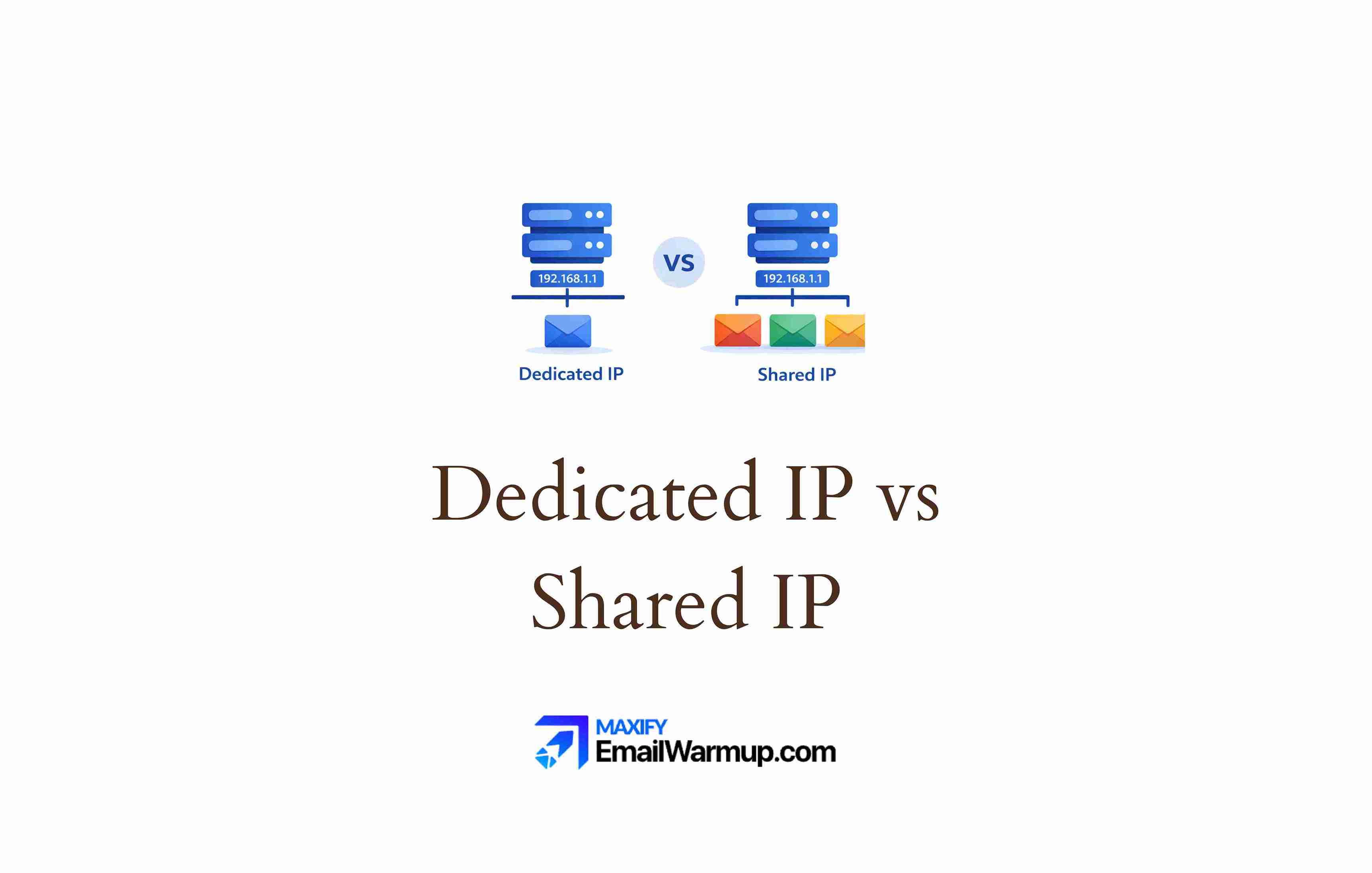
A dedicated IP gives you complete control over your sender reputation — no other company’s behavior affects your email deliverability. A shared IP pools reputation across multiple senders, spreading risk but exposing you to others’ mistakes.
The decision isn’t about which is “better.” It’s about which matches your situation:
- Shared IPs work better for lower volumes and inconsistent sending patterns
- Dedicated IPs require high, consistent volume to maintain reputation
- The wrong choice hurts deliverability either way
Most senders default to shared IPs without realizing it. ESPs like Mailchimp, Klaviyo, and SendGrid place new accounts on shared infrastructure automatically. Dedicated IPs require explicit setup, additional cost, and careful management.
What is a dedicated IP?
A dedicated IP address is used exclusively by your organization. Every email you send originates from that IP — and no one else’s email ever does.
Exclusive ownership
Your reputation on a dedicated IP reflects only your sending behavior:
- Your bounce rates
- Your spam complaints
- Your engagement patterns
- Your authentication setup
No external factors influence how mailbox providers view your IP. Complete control means complete accountability. If your reputation drops, you caused it. If reputation climbs, you earned it.
The isolation works both ways. A competitor’s spam campaign won’t drag you down. But your own mistakes have nowhere to hide — there’s no pool of good senders to buffer a bad day.
What is a shared IP?
A shared IP is used by multiple senders — sometimes dozens or hundreds. Your emails share the IP reputation with everyone else using it.
Pooled reputation
Good ESPs carefully manage shared IP pools:
- Monitoring sender behavior across the pool
- Removing senders who damage reputation
- Rotating IPs when problems arise
- Maintaining overall pool health
The quality of your shared IP depends heavily on your ESP’s policies. Strict ESPs maintain clean pools. Permissive ESPs expose you to bad neighbors whose spam complaints and bounces affect your deliverability.
Shared IPs function like apartment buildings. Well-managed buildings with strict tenant policies stay desirable. Buildings that accept anyone become problematic addresses — regardless of how good your individual unit looks.
How much volume do you need for a dedicated IP?
Dedicated IPs require consistent volume to build and maintain reputation. Without enough sending activity, mailbox providers lack data to evaluate you — and default to skepticism.
| Monthly volume | Recommendation | Reasoning |
| Under 50,000 | Shared IP | Insufficient volume to maintain reputation |
| 50,000–100,000 | Case-by-case | May work if highly consistent |
| 100,000–500,000 | Dedicated viable | Enough volume to build and maintain |
| 500,000+ | Dedicated recommended | Volume supports multiple dedicated IPs |
The 100,000/month figure isn’t arbitrary. Below that threshold, sending gaps creates reputation decay. Mailbox providers forget about you. When you resume sending, you’re starting from a weaker position than where you left off.
Also, sending 200,000 emails once per quarter doesn’t work for dedicated IPs. The long gaps between sends cause reputation to atrophy. A sender doing 50,000/month consistently often outperforms one doing 150,000 sporadically.
Volume without consistency is worse than lower volume with reliability. The pattern matters as much as the total.
What are the tradeoffs of each option?
Neither option is universally superior. Each comes with advantages that match specific situations — and disadvantages that punish the wrong fit.
| Factor | Dedicated IP | Shared IP |
| Reputation control | Full control | Shared with others |
| Volume requirement | 100K+/month typical | No minimum |
| Warmup needed | Yes (4-8 weeks) | No |
| Cost | Higher | Lower/included |
| Risk from others | None | Yes |
| Risk from yourself | 100% exposure | Diluted by pool |
| Recovery from damage | Slower | Faster |
Dedicated advantages
Dedicated IPs shine when you need isolation:
- No bad neighbor risk
- Brand protection for compliance-sensitive industries
- Separate streams for transactional vs marketing mail
- Full reputation control (your behavior alone determines outcomes)
Dedicated disadvantages
The control comes with responsibility:
- Higher cost
- Volume requirements that don’t flex
- IP warmup required (4-8 weeks minimum)
- Reputation damage is 100% your problem
- Recovery is slower (only your volume rebuilds trust)
Shared advantages
Shared IPs offer stability without maintenance:
- No volume minimums
- Faster recovery from problems
- The pool absorbs occasional issues
- Lower cost (usually included in standard pricing)
Shared disadvantages
Pooled reputation has pooled risks:
- Limited visibility into overall IP health
- Blocklist exposure from senders you’ve never met
- Bad neighbor effect (others’ problems become yours)
- Less isolation for sensitive use cases
How does email warmup differ between the two?
The warmup question often drives the decision. Dedicated IPs demand patience. Shared IPs skip the process entirely.
Dedicated requirements
New dedicated IPs have no sending history — mailbox providers don’t know whether to trust them. Warmup involves gradually increasing volume over weeks while maintaining strong engagement metrics.
The process requires:
- Starting with your most engaged subscribers
- Slowly increasing daily volume (typically doubling every few days)
- Monitoring deliverability metrics throughout
- Patience (rushing causes problems that take longer to fix)
A proper warmup takes 4-8 weeks. During that time, sending capacity is limited. Plan for reduced campaign volume or maintain shared IP access temporarily.
Shared advantage
Shared IPs skip warmup entirely. The IP already has an established sending history from other senders. You inherit the pool’s reputation immediately — which is good if the pool is healthy, risky if it’s not.
For senders who can’t wait weeks to reach full volume, shared IPs eliminate a significant barrier. The tradeoff is accepting whatever reputation the pool carries.
When should you choose a dedicated IP?
Dedicated IPs make sense when you can meet the requirements and benefit from the isolation.
| Scenario | Why dedicated works |
| High volume (100K+/month) | Enough data to build standalone reputation |
| Consistent cadence | Daily/weekly sending maintains IP activity |
| Strict compliance needs | Industries requiring reputation isolation |
| Brand protection priority | Don’t want reputation tied to unknown senders |
| Transactional + marketing split | Separate IPs for different mail streams |
The key question is…can you maintain the IP?
Volume, consistency, clean lists, and active monitoring are all requirements — not nice-to-haves. Missing anyone creates problems that shared IPs would have avoided.
Finance, healthcare, and enterprise SaaS often need dedicated IPs for compliance reasons. Transactional email frequently runs on a dedicated infrastructure separate from marketing campaigns.
When should you choose a shared IP?
Shared IPs make sense when dedicated requirements don’t fit your situation. Choosing shared isn’t settling for less — for many senders, shared IPs deliver better results.
| Scenario | Why shared works |
| Low volume (<50K/month) | Insufficient volume for dedicated |
| Inconsistent sending | Campaigns vs always-on sending |
| Starting out | No sending history to leverage |
| Budget constraints | Dedicated IPs cost more |
| Good ESP with strict policies | Pool quality is maintained |
A sender doing 20,000 emails monthly on a dedicated IP struggles to maintain a reputation. The same sender on a well-managed shared pool benefits from the volume and consistency of other senders — reputation stability they couldn’t achieve alone.
The ESP choice matters enormously for shared IP success. Ask about sender policies, pool management, and what happens when bad senders are detected. Strict ESPs protect their shared pools. Permissive ESPs expose you to risk.
For help evaluating which setup matches your sending program, an email deliverability consultant can analyze your specific situation and recommend the infrastructure that supports your goals.
Can you switch between dedicated and shared?
Transitions are possible but require planning.
Moving to dedicated
Switching from shared to dedicated requires treating the new IP as completely fresh.
Your history on shared IPs doesn’t transfer. You’ll need to warm up from scratch — the 4-8 weeks apply regardless of how long you’ve been sending.
Plan for reduced capacity during warmup. Some senders maintain both temporarily, gradually shifting volume to the dedicated IP as warmup progresses.
Moving to shared
Switching from dedicated to shared is simpler. You’re joining an established pool. The main consideration is ensuring your new ESP’s shared pool is well-managed.
Your dedicated IP reputation doesn’t follow you — but that’s often fine. You’re inheriting the pool’s reputation, which may be stronger than what you’d built.
How do you monitor IP reputation?
Visibility varies significantly between dedicated and shared setups. Knowing your reputation status helps catch problems before they escalate.
For dedicated
Monitor your specific IP using:
- Third-party reputation services
- Microsoft SNDS (Outlook/Hotmail visibility)
- Your own bounce and complaint rate tracking
- Google Postmaster Tools (Gmail reputation data)
Problems are yours alone — and you’ll see them directly in these tools. Run regular email deliverability tests to verify inbox placement matches reputation indicators.
For shared
You have less visibility into overall IP health. Focus on what you can measure:
- ESP-provided reputation dashboards
- Sudden changes without corresponding changes to your sending
- Your own deliverability metrics (inbox placement, bounces, complaints)
If deliverability drops suddenly without changes on your end, the shared IP may have problems. Contact your ESP — they should be monitoring pool health and can confirm whether issues are IP-related or something in your specific sending.
Frequently asked questions
Here are some commonly asked questions about dedicated and shared IPs:
No. A dedicated IP gives you control — not automatic improvement. If your sending practices are poor (bad lists, low engagement, weak authentication), dedicated IP makes things worse. There’s no pool to buffer mistakes, and recovery depends entirely on your own volume.
Yes. High-volume senders often use separate IPs for transactional email (receipts, password resets) and marketing email (campaigns, newsletters). Keeping streams separate prevents marketing reputation from affecting critical transactional delivery.
Monitor your deliverability metrics. If inbox placement drops suddenly without changes to your sending, the shared pool may have issues. Run an email deliverability test and contact your ESP if problems persist.
Only if you meet the requirements for qualifying senders (volume, consistency, clean lists, monitoring capability) does a dedicated IP provide valuable control. For those who don’t, the extra cost buys worse deliverability — not better.