
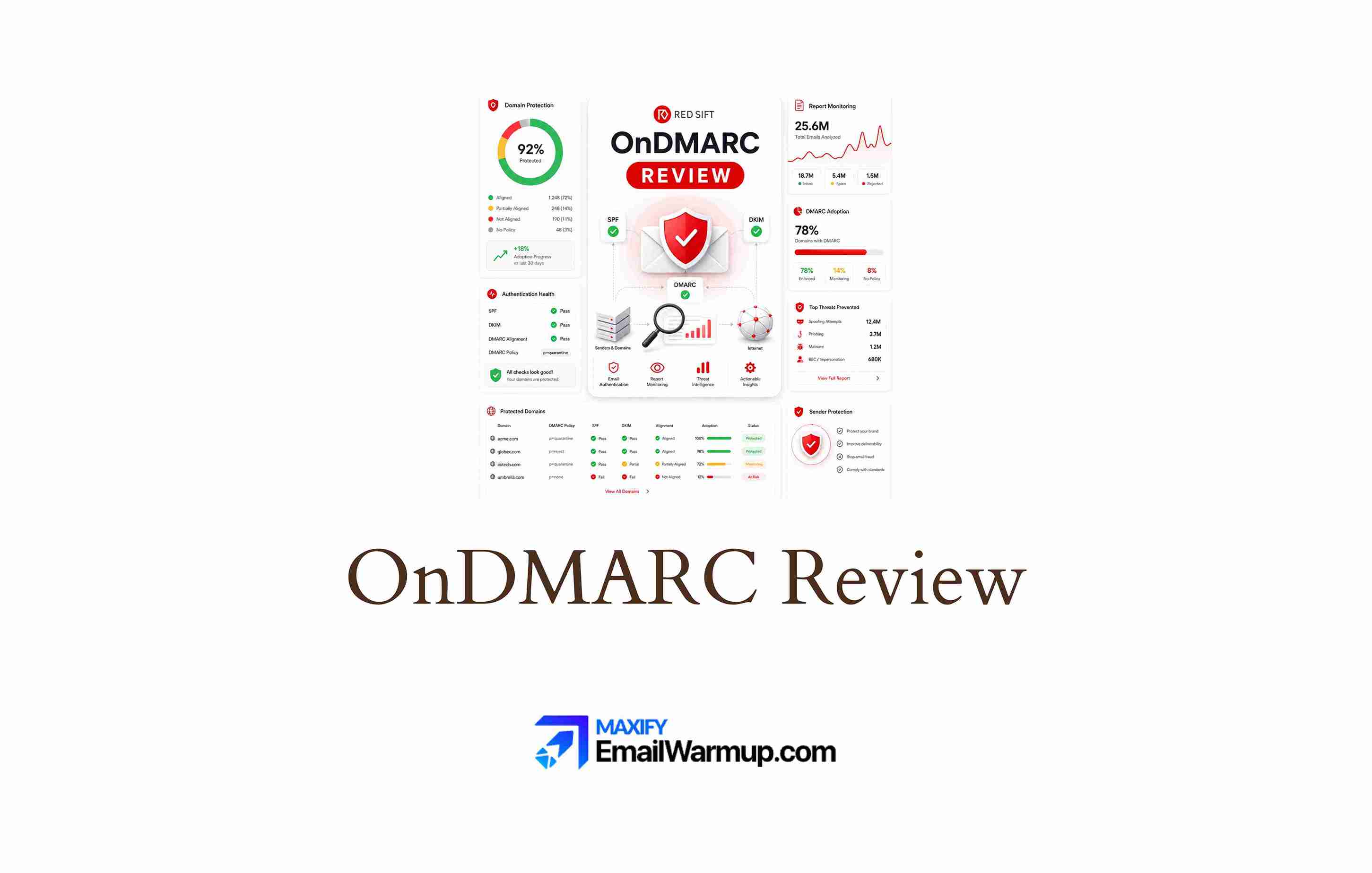
OnDMARC is Red Sift’s automated DMARC management product. It helps organizations deploy DMARC, align SPF and DKIM authentication, monitor email traffic, and move toward full enforcement (p=reject) with step-by-step guidance and automated record management.
From a deliverability consultant’s perspective, OnDMARC solves a real and persistent problem. DMARC implementation is one of the highest-impact authentication steps a sender can take — and one of the most commonly botched.
Misconfigured records, stale SPF includes, unaligned DKIM selectors, and the fear of breaking legitimate email flows keep many organizations stuck in monitoring mode indefinitely. OnDMARC’s automated approach accelerates the path to enforcement, which directly improves both security and deliverability.
The platform has strong review data — 4.8/5 on G2 (107 reviews), 5.0/5 on Gartner Peer Insights, and 4.9/5 on Capterra (17 reviews). Support quality is praised consistently across every platform. The main reservation is pricing, which leans enterprise-level and may be steep for smaller senders or mid-market teams.
In this review, we would be exploring:
- Pricing positioning and where the cost makes sense
- Who benefits most and who can solve authentication differently
- Whether OnDMARC accelerates DMARC enforcement meaningfully
- Feature depth beyond DMARC (SPF flattening, BIMI, MTA-STS)
TLDR: OnDMARC at a glance
Here is a quick summary of where OnDMARC sits in the authentication and domain protection category.
| Category | Detail |
| Primary function | DMARC deployment, SPF/DKIM alignment, monitoring |
| Pricing model | Enterprise-oriented (not publicly granular) |
| Free trial | 14-day trial available |
| Standout feature | Automated SPF/DKIM/DMARC management with dynamic services |
| Biggest weakness | Enterprise pricing limits accessibility for smaller senders |
| Best alternative | EmailWarmup.com’s free DMARC tools |
| Overall rating | 4.0 / 5 |
Is OnDMARC worth the enterprise price?
OnDMARC’s pricing is enterprise-oriented. G2 data estimates annual costs in the thousands (based on user-reported purchase data), and multiple reviewers note the pricing feels geared toward larger organizations. Red Sift offers a 14-day free trial, which helps evaluate the platform before committing.
The price makes sense when:
- You manage 10+ domains that need DMARC enforcement
- You need guided enforcement rather than manual DNS management
- Your organization sends through multiple ESPs and third-party services
- SPF lookup limits (the 10-lookup cap) are causing authentication failures
The price is harder to justify when:
- Free DMARC generators and SPF generators can handle your setup
- You manage fewer than 5 domains with straightforward authentication
- Your deliverability needs extend beyond authentication (warmup, list hygiene, testing)
For organizations where DMARC failure means phishing risk, brand damage, and deliverability collapse across hundreds of domains, OnDMARC’s automation earns its premium. For smaller operations, the same authentication outcomes are achievable with free tools and manual DNS work.
What OnDMARC’s deployment data reveals about authentication impact
OnDMARC’s user reviews paint a consistently positive picture of its core function — helping organizations reach DMARC enforcement faster and with less risk of breaking legitimate email.
Deployment speed
Multiple G2 reviewers report reaching p=reject (full enforcement) across dozens or hundreds of domains within months. One reviewer cited moving 1,000+ domains to reject policy in under 9 months. For context, manual DMARC deployment at that scale would typically take years and require dedicated engineering time.
SPF management
OnDMARC’s dynamic SPF feature solves the 10-lookup limit — a persistent headache for organizations with many sending services. By hosting and flattening SPF records automatically, the platform removes one of the most common causes of SPF authentication failures at scale.
Visibility and reporting
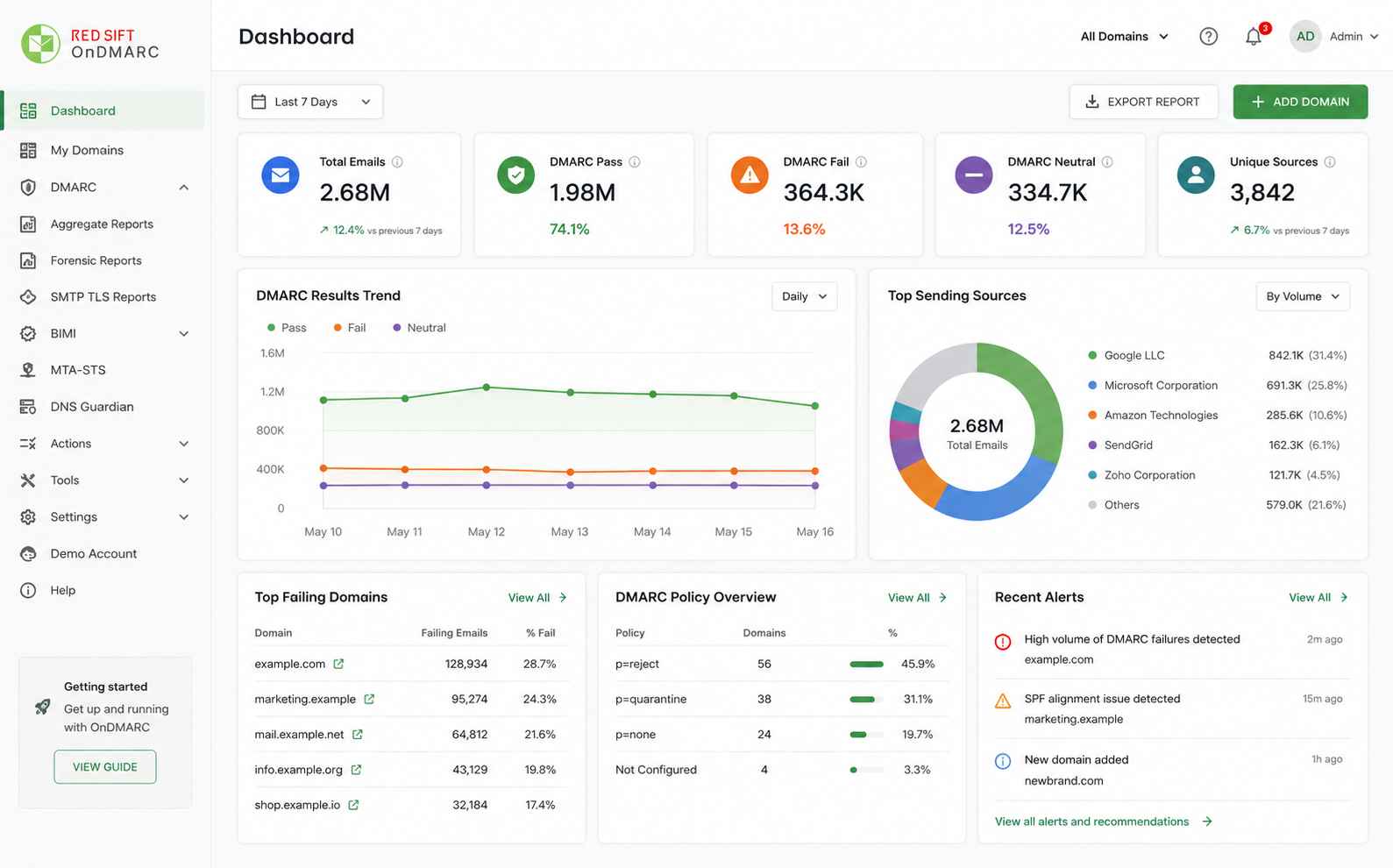
The dashboard provides clear visibility into sending sources, authentication pass/fail rates, and alignment status. Reviewers consistently praise the reporting as “intuitive” and “actionable” — a meaningful distinction from raw DMARC XML reports that most technical teams find unreadable without specialized tools.
Pros and cons of OnDMARC
OnDMARC excels at making DMARC deployment manageable at enterprise scale. The tradeoffs are pricing accessibility and a narrow focus on authentication that leaves other deliverability factors unaddressed.
Who should and shouldn’t use OnDMARC
OnDMARC is built for organizations where DMARC complexity exceeds what manual management can handle. For simpler setups, free tooling covers the same ground.
Who should use OnDMARC
- Teams hitting SPF lookup limits that need dynamic flattening
- Companies prioritizing brand protection against domain spoofing
- Enterprise security teams managing DMARC across 10+ domains
- Organizations sending through multiple ESPs and third-party services
Who shouldn’t use OnDMARC
- Teams that need warmup, email deliverability testing, or consultation
- Small senders managing 1-5 domains with straightforward authentication
- Budget-constrained teams where free DKIM and SPF generators handle the need
- Outbound-focused teams whose deliverability problems extend beyond authentication
OnDMARC scorecard for email security and deliverability
| Category | Score (out of 10) | Notes |
| DMARC management | 9 | Guided enforcement with automation |
| SPF handling | 9 | Dynamic flattening solves lookup limits |
| DKIM management | 8 | Hosted records reduce manual DNS work |
| Reporting clarity | 8 | Clear dashboards praised across reviews |
| Support quality | 9 | Consistently rated excellent |
| Pricing accessibility | 4 | Enterprise-oriented, steep for smaller orgs |
| Deliverability breadth | 3 | Authentication only — no warmup or testing |
| Overall value | 7 | Excellent at authentication, narrow in scope |
How OnDMARC fits into an email authentication workflow
OnDMARC sits at the authentication and domain protection layer of the deliverability stack. It does not address warmup, content, list quality, or sending infrastructure — but what it does cover, it handles well.
DMARC deployment
The platform walks you through policy stages (none → quarantine → reject) with visibility into what each change affects. The guided approach reduces the fear of blocking legitimate email — the primary reason organizations delay enforcement.
Ongoing management
Automated record updates, sending source discovery, and alignment monitoring run continuously. When a new ESP or third-party service starts sending on your behalf, OnDMARC surfaces it immediately.
Extended protocols
BIMI support (with integrated VMC provisioning) and MTA-STS hosting extend the platform beyond DMARC into broader email security. For organizations pursuing brand recognition in the inbox (BIMI logos) or encrypted transport (MTA-STS), the bundled approach saves integration effort.
What happens after you stop using OnDMARC?
DMARC records are DNS entries — they persist regardless of whether you keep the platform. But the management layer disappears.
- Automated monitoring and alerting end immediately
- Ongoing alignment drift becomes your team’s manual responsibility
- DMARC, SPF, and DKIM records remain active in DNS after cancellation
- Dynamic SPF flattening stops, which may reintroduce lookup-limit failures
- New sending sources added by your organization go undetected until manually reviewed
For organizations with simple domain setups, the transition is manageable. For enterprises with dozens of sending services across many domains, losing the automated management layer creates real operational risk.
A better alternative to OnDMARC | EmailWarmup.com
OnDMARC handles DMARC management well, but its scope stops at authentication. EmailWarmup.com includes authentication tools as part of a broader deliverability platform that audits, fixes, and monitors everything affecting inbox placement.
EmailWarmup.com’s free authentication tools cover the same ground OnDMARC charges enterprise pricing for:
- Unlimited deliverability testing across 50+ providers
- SPF lookup and SPF generator for record validation and creation
- Unlimited deliverability consultation for guided authentication deployment
- DKIM lookup and DKIM generator for signing verification and key generation
- DMARC lookup and DMARC generator for policy checks and record creation
For organizations that need DMARC and warmup, testing, reputation monitoring, and expert guidance, EmailWarmup.com provides the full system — not just the authentication layer.
Final verdict on OnDMARC
OnDMARC is one of the stronger DMARC management platforms available. Guided enforcement, dynamic SPF, automated DKIM hosting, and clear reporting make it a genuine time-saver for enterprise security teams managing complex multi-domain authentication.
- Dynamic SPF flattening solves the 10-lookup limit cleanly
- Accelerates DMARC enforcement from months to weeks at enterprise scale
- Authentication-only scope leaves warmup, testing, and consultation unaddressed
- Enterprise pricing limits accessibility for mid-market and smaller teams
- Support quality is excellent across every review platform
If DMARC enforcement across many domains is your primary challenge and budget supports enterprise tooling, OnDMARC delivers. If authentication is one piece of a broader deliverability problem, a platform that covers the full system will serve you better.
Frequently asked questions about OnDMARC
Here are common questions organizations ask before choosing OnDMARC.
DMARC enforcement directly improves deliverability by authenticating your sending sources and preventing spoofing. Mailbox providers (especially Gmail and Microsoft) reward authenticated senders with better placement. OnDMARC accelerates the enforcement process, which has downstream deliverability benefits.
For organizations managing 1-5 domains with simple sending setups, free tools like EmailWarmup.com’s DMARC generator and SPF generator can handle authentication without enterprise pricing. OnDMARC’s value scales with domain complexity.
Reviewers report reaching p=reject in 6-8 weeks for standard deployments and a few months for complex multi-domain setups. Manual DMARC deployment without tooling typically takes much longer — often 6-12 months for organizations with many sending services.
The platform covers SPF, DKIM, BIMI, and MTA-STS alongside DMARC. It does not cover warmup, list hygiene, inbox placement testing, or deliverability consultation.