

Sender Score by Validity assigns a number between 0 and 100 to your sending IP address — a quick health signal that reflects how mailbox providers view your sending behavior. The concept is simple, and the tool has been around since 2006, making it one of the oldest reputation indicators in email.
The problem is that Sender Score occupies an awkward middle ground in 2026.
The free version (which most senders use) provides a single number without the context needed to act on it. The paid version sits behind Validity’s enterprise products — Everest and Sender Certification — which are priced for large-scale senders, not the mid-market teams who need visibility into reputation the most.
A Reddit thread from r/sysadmin captures the frustration well. A small mail server operator watched his Sender Score decline until Microsoft started black-holing his emails.
Validity’s support told him his volume was too low to raise the score — and offered to sell him consulting to improve it. The perception of a conflict of interest (score the reputation, then charge to fix it) has followed Sender Score for years.
This review covers:
- Where reputation monitoring fits in a complete deliverability strategy
- The free-to-paid divide and what gets locked behind enterprise pricing
- What Sender Score actually measures and where the number falls short
- A stronger alternative that connects reputation to diagnosis and fixes
- Whether IP reputation scoring remains a useful deliverability signal
TLDR: Sender Score at a glance
Here is a quick summary of what Sender Score provides and where it sits in the deliverability landscape.
| Category | Detail |
| What it is | IP reputation scoring service (0-100 scale) by Validity |
| Best for | Enterprise senders using Validity’s Everest platform for holistic reputation monitoring |
| Deliverability impact | Diagnostic only — provides a reputation number but no tools to fix underlying issues |
| Main limitation | Penalizes low-volume senders; free version lacks actionable depth; paid tools are enterprise-priced |
| Best-fit user | Large-scale email operations with dedicated deliverability teams |
| EmailWarmup.com alternative fit | Domain reputation check with unlimited deliverability consultation |
Is Sender Score’s free reputation check worth anything?
The free Sender Score lookup gives you a single number. That number reflects your IP reputation based on data from over 100 mailbox providers globally — covering spam complaints, unknown-user rates, blacklist appearances, and related sending-behavior signals.
The problem is what the free version does not include. There is no trend data, no breakdown of which factors are dragging down the score, and no recommendations for improvement.
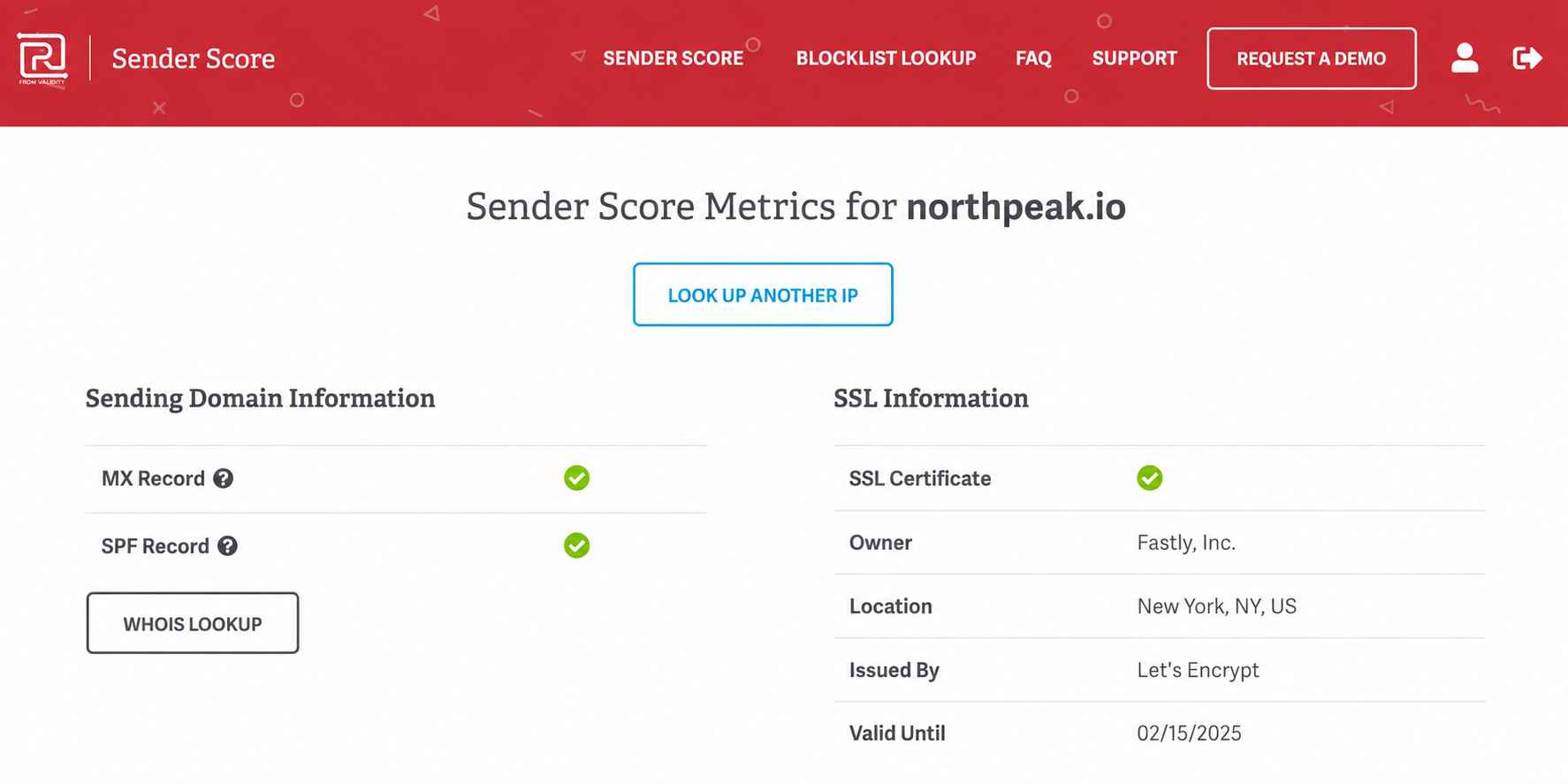
A score of 72 tells you something is wrong, but does not tell you what or how to fix it. That context lives behind Validity’s paid products (Everest starts at enterprise pricing with custom quotes).
For small and mid-volume senders, the free score creates a frustrating loop. Low volume itself suppresses the score (Validity’s own support has confirmed this), which means legitimate senders with small lists can see their scores decline through no fault of their own.
When those scores trigger filtering at providers like Microsoft (which uses reputation data in its spam decisions), the sender is stuck — unable to raise the score without more volume, and unable to send more volume without better inbox placement.
What Sender Score’s reputation model reveals (and conceals)
Sender Score measures one dimension of deliverability — IP reputation. Let’s look at what the score captures and what it misses, which is critical for interpreting the number correctly.
IP reputation
The 0-100 score aggregates signals from mailbox providers worldwide. Spam complaints, bounce rates, unknown user hits, and blacklist appearances all factor in.
The score reflects historical behavior for a specific IP address, making it most useful for dedicated IP senders who control their sending patterns.
Shared IP blindspot
Senders on shared IPs (common with lower-tier ESP plans) inherit the reputation of every other sender on that IP.
A low Sender Score might reflect a neighbor’s bad behavior rather than your own — and the free tool provides no way to distinguish between the two. Dedicated IPs (available on higher-tier ESP plans) give cleaner data but also cost more.
Volume bias
Validity’s own support has stated that low sending volumes prevent scores from rising.
The logic behind the bias is understandable (more data produces more confident scoring), but the practical effect punishes small, legitimate senders.
A charity sending 100 emails per week to opted-in parents can see its Sender Score decline simply because the volume is too low for Validity’s system to score confidently.
The upsell perception
Multiple users across Reddit and review platforms describe Sender Score as feeling like a funnel for Validity’s paid products. The free score identifies a problem.
The solution requires Everest (for monitoring) or Sender Certification (for reputation whitelisting) — both enterprise-priced. Whether intentional or not, the dynamic creates a perception of conflict that has followed the product for years.
Pros and cons of Sender Score
Sender Score provides a useful directional signal for enterprise senders, but the lack of actionable depth and the volume bias limit its value for most teams.
- Free, instant IP reputation check available to anyone
- Aggregates data from 100+ mailbox providers globally
- Established since 2006 — widely recognized in the industry
- Useful as a quick directional pulse check for dedicated IP senders
- Free version provides no actionable breakdown or recommendations
- Penalizes low-volume senders regardless of sending quality
- Paid tools locked behind enterprise-level Validity subscriptions
- Shared IP senders cannot distinguish their reputation from neighbors
- No reviews on SourceForge; minimal independent validation available
Who should and shouldn’t use Sender Score
Sender Score’s fit depends almost entirely on your sending scale and whether you already invest in Validity’s broader platform.
Who should use Sender Score
- Enterprise email operations with dedicated IPs and in-house deliverability teams
- Senders already using Validity’s Everest platform who want reputation data in context
- Deliverability consultants who need a quick IP health check during audits
Who shouldn’t use Sender Score
- Teams on shared IPs who need to understand their individual reputation
- Small and mid-volume senders who cannot overcome the low-volume scoring penalty
- Anyone looking for tools that diagnose and fix deliverability problems — not just score them
- Senders who need domain reputation monitoring alongside IP reputation (Sender Score covers IPs only)
Sender Score scorecard for deliverability teams
Here is how Sender Score rates across categories relevant to teams evaluating reputation monitoring.
| Category | Rating | Notes |
| Data breadth | ★★★★☆ | Aggregates from 100+ providers — strong data foundation |
| Actionable insights | ★★☆☆☆ | The free version provides a number without context or recommendations |
| Accessibility | ★★☆☆☆ | Meaningful tools gated behind enterprise pricing |
| Low-volume fairness | ★☆☆☆☆ | Volume bias penalizes legitimate small senders |
| Deliverability impact | ★★☆☆☆ | Diagnostic only — no tools to fix what the score reveals |
| Independent validation | ★☆☆☆☆ | No reviews on SourceForge; minimal third-party assessment |
How Sender Score fits into a reputation monitoring workflow
Sender Score works as one data point in a broader reputation monitoring strategy. Treating it as a standalone deliverability solution leads to frustration — the tool was never designed to operate independently.
Quick health check
Typing your IP into senderscore.org and reading the number takes seconds. If the score is above 80, your IP reputation is generally healthy. Below 70, something needs investigation. The number is useful as a trigger for further diagnosis, not as a diagnosis itself.
Context from other tools
Sender Score covers IP reputation only. Domain reputation (tracked through Google Postmaster Tools and Microsoft SNDS) provides a separate, often more actionable signal. Authentication status (SPF, DKIM, DMARC) affects both IP and domain reputation. Sender Score captures none of these dimensions.
Enterprise integration
For teams using Validity’s Everest, Sender Score data feeds into broader monitoring dashboards with trend analysis, inbox placement testing, and competitive benchmarking. At that tier, the score becomes part of a useful system. Outside that ecosystem, the score floats without context.
What happens after you stop using Sender Score?
There is nothing to stop using — the free version requires no account, subscription, or integration.
You visit the website, enter an IP, and read the number. No data persists, no monitoring runs in the background, and no historical tracking exists on the free tier.
For teams using Sender Score through Validity’s paid products, cancellation removes access to trend data, monitoring alerts, and the contextual reporting that makes the score actionable. IP reputation data itself does not transfer — it remains within Validity’s systems.
A better alternative to Sender Score | EmailWarmup.com
Sender Score tells you your IP reputation number. EmailWarmup.com tells you why your reputation is where it is — and gives you the tools and expertise to improve it.
EmailWarmup.com provides reputation monitoring as part of a complete deliverability system:
- Unlimited deliverability consultation so reputation problems become actionable fixes
- IP reputation and domain reputation tracking across your sending infrastructure
- Authentication auditing for SPF lookup, DKIM checker, and DMARC lookup
- Blacklist monitoring and remediation when listings occur
Sender Score gives you a number. EmailWarmup.com gives you the diagnosis, the tools, and the expert guidance to change it.
Final verdict on Sender Score
Sender Score remains a recognizable brand in email deliverability, and the free IP reputation check provides a quick directional signal. For enterprise senders embedded in Validity’s ecosystem, the score feeds into broader monitoring that adds real value.
The limitations for everyone else are significant:
- Meaningful tools are gated behind enterprise pricing
- The free version provides a number without context or recommendations
- Low-volume senders face a scoring penalty that they cannot overcome through better practices
- IP reputation is one dimension of deliverability — domain reputation, authentication, and engagement matter as much or more
For teams that need reputation visibility connected to diagnosis and fixes, Sender Score provides the starting point, but none of the follow-through.
Frequently asked questions about Sender Score
Here are the most common questions buyers ask when evaluating Sender Score.
The basic IP reputation lookup is free. Typing your IP address into senderscore.org returns a score between 0 and 100. Detailed analytics, trend data, and monitoring tools require paid Validity subscriptions through products like Everest or Sender Certification, both priced for enterprise customers.
No. Sender Score reflects IP reputation, which is one of many factors mailbox providers evaluate. Domain reputation, authentication configuration, engagement history, content quality, and provider-specific filtering all influence where your emails land. A high Sender Score helps but does not guarantee inbox delivery.
Validity’s scoring model relies on sufficient data to generate confident reputation assessments. Low sending volumes produce less data, which the system interprets as insufficient evidence of good sending behavior. The practical effect is that small, legitimate senders can see declining scores — and corresponding filtering at providers like Microsoft — despite following every best practice.
Sender Score measures IP reputation using data from 100+ mailbox providers. Google Postmaster Tools measures domain and IP reputation specifically within Gmail’s ecosystem. Both are useful, but Google Postmaster Tools provides more granular, actionable data for Gmail-specific deliverability (which represents a large share of most senders’ lists). Neither tool fixes the problems they identify.